



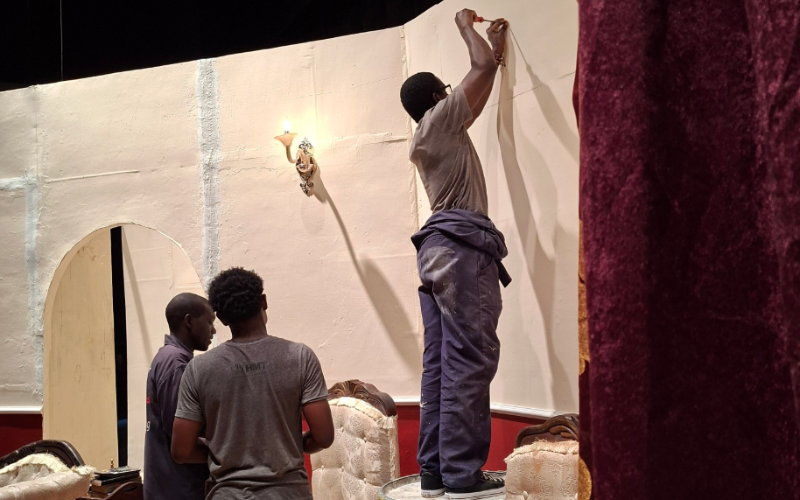
Kahwai Njoroge ventured into the theatre scene in 2018 and assembled a crew that works in set design, lighting, and sound technical production in what became The Blacks, a theatre technical production company.
Their stage credits include Ngaahika Ndeenda (I Will Marry When I Want), The Trial of Dedan Kimathi, and Sarafina! The Musical, Scrooge, Betrayal in the City, Antigone, Vienyeji Pro Max, Kaggia, Mtakatifu Bonoko, and Mgonjwa Mwitu are presented by the Nairobi Performing Arts Studio (NPAS).
They have also built stages for Matatu Musical by Pawa254, Redemption presented by the Kenya Cultural Centre, and Gikuyu na Mumbi by Kwa Ndego Productions.
He says technical theatre is one of the most misunderstood areas in performance work, despite being vital to how productions come alive on stage.
“It is a field not known to many. It demands a level of problem-solving and critical thinking that cannot easily be automated. This is an area that is well advanced and cannot be replaced by AI very soon,” Njoroge says.


The Blacks, he explains, were built around the idea of stabilising productions when they are under pressure backstage.
“If you are working backstage, you need to be quick and know how to handle and help reduce pressures so that the production goes on smoothly,” he says.
Much of this work relies on collaboration with everyone in the production, especially directors and performers since they are conversant with their characters and what the director wants to achieve.
A part of their process is interpreting the script to know where stage elements such as set, props, lighting, and sound systems are installed and tested before a show.
Before any stage is built, sketches and technical calculations are done to test feasibility. He worked in Kaggia, a historical biographical play put on stage by NPAS last year, about freedom fighter Bildad Kaggia. The piece had a revolving stage which director Stuart Nash required.

Technical week becomes the most important phase in the production timeline, where set changes, costume changes, lighting cues, and transitions are tested repeatedly until they work. Most scene changes, he notes, happen in blackout and must be executed quickly and precisely.
He also shares how technical cues support actors on stage, and without it, theatre loses its depth and is reduced to dialogue alone.
“If they see a light change from red to blue, it means they need to go on stage. If there is an effect of gunshot, it cues them to run around,” he says.
One of the challenges in the industry has been the invisibility of backstage work and the assumption that anybody could do it. Before the Blacks came onto the scene, he says, technical crews were not treated as professionals in their own right.
“People used to believe anybody could be backstage crew. People did not treat it as a career like any other. When we came in, we also started treating everyone in the production as part of it,” he recalls.
The other challenge is productions coming up with pre-set budgets that do not match the technical demands of the show. In some cases, the team recycles materials to build stages; other times, they decline work if basic welfare and staffing needs are not met.

Productions are usually staged in non-traditional venues. For Scrooge, performed at Karen Country Club in an open field, the team adapted available materials to build a functioning stage.
“When the stage is built with platforms used for events or with weaker materials, it is not fully sufficient for doing activities on it. A poorly built stage can bring an entire production down,” he says.
For him, the most challenging productions are those with static, unchanging sets with little movement.
He observes that technical theatre is growing, with more productions embracing silhouette work, soundscapes, makeup effects, and programmable lighting systems to enhance storytelling.
However, when it comes to stages, he says that a lot needs to be done. He argues that many theatre spaces are makeshift, with limited access to permanent or rotating stage systems that can be utilised for more complex storytelling.
“We need to adequately invest in technical theatre to create stable employment structures and improve consistency in production work and concrete government policies to expand the practice outside of Nairobi,” he notes.
Photos: Courtesy