

Audio By Vocalize
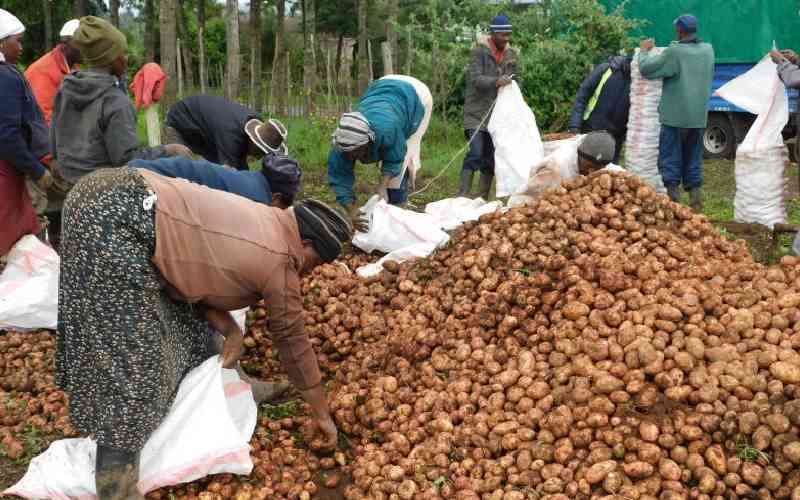
Potato harvesting and packaging in Kinangop, Nyandarua County. [File, Standard]
Nyandarua County was in the news recently for all the wrong reasons, the epicentre of political contest during a funeral ceremony.
It’s a quiet county known for mountains, milk, potatoes and a few myths. Few know about it; it’s an enigma. Through my visits and genetic links, I shall try to lift the veil over this county.
The county is seen as the backwaters of central Kenya, referred to as rúgúrú (west). It is hidden from the rest of central Kenya by the Aberdares (Nyandarua).
The county’s enigma starts with ownership. It has no core owners, and ownership has changed over the years.
The Maasai owned this land till the agreements of 1904 and 1911. The names in that county reflect that history, including Ol Kalou, the epicentre of last week’s political drama. Add Ol Joro Orok, Shamata, Kinangop, and Kipipiri, among others.
Then came the mzungu (whites) with Happy Valley as the epicentre in the rolling 1920s. The Kenya Gazette copies have lists of wazungus who once made this land their home. Like the Maasai, they left their footprints in big houses and corrupted names like Mboimani (Bowman), Kaniki (Carnegie), Thimiti (Smith), Kanari (colonel), Ndaya (Dyer), De Wet, Crous, and many others.
The history of Kenya gives too much airtime to Britons at the expense of Afrikaners (Boers). Their presence in Nyandarua has a lot to do with the similarity between South Africa’s Western Cape Province and Nyandarua, except for wine growing.
It’s as if God copied. We had other nationalities like Italians and Australians in this county.
A new set of owners came through the settlement schemes after Uhuru (independence). They came from neighbouring counties like Nyeri and Kiambu. Rarely from Murang’a, who preferred Nairobi. Others got there as former mzungu employees. The vast majority were squatters in various places, like Njiru in Nairobi and Embu.
The county has another class of owners: non-Gíkúyú speakers. You will meet Ekai or Musyoka, who speaks fluent Gíkúyú. These “minorities “got there during the Mau Mau liberation war.
Home counties
Once mzungu realised his workers had secretly joined Mau Mau, he repatriated them to their original home counties, mostly Nyeri, Kiambu and Murang’a. Curiously few Nyandaruans or Nyandarese have links to Kirinyaga.
They (Gíkúyú) workers were replaced by these minorities because plantations had to run from dairying to tending crops like pyrethrum.
Gikuyu workers returned later after “the new workers” were found wanting. Nduhiu Wang’ombe (late) and Kamwaro Kimani shared their story on returning to Four Winds Farm, owned by General Wainwright.
Nyandarua is like the United States, without the integration spirit. Echoes of where one came from still reverberate.
It usually comes mostly in leadership positions from chiefs to headmasters and representatives like governors, women representatives, MPs and Members of County Assemblies (MCAs).
That explains partly why the county is less developed compared with other central Kenya counties.
This “ownership” is the genesis of Nyandarua’s political problems. The life wires to “mother counties” make it easy for carpetbaggers to thrive.
In addition, the Mau Mau aftershock echoed long after the new immigrants settled. They did not have the social capital to join the modern economy; they had been on the move, courtesy of counterinsurgency measures against Mau Mau.
The county is about to get the next generation of owners, as the land is subdivided further. Masai had limitless land, mzungu had less, and the next generation will own even less. Without industrialisation, the next generation is in a tight corner; no land, no jobs. That partly explains why the political rally was so “hot.”
Sadly, the big pieces of land (compared with, say, Murang’a) were the soft underbelly; it made the immigrants too “settled” and comfortable.
Beyond land subdivision and history of subjugation, working for mzungu or fighting him, deep attachment to religion can further explain the slow economic transformation of this county.
Some suggest the county is haunted by the ghost of Happy Valley, and religion is needed to fight these ghosts.
What next for beloved county?
A few agro-based industries are pitching a tent in Nyandarua. Examples are Eldoville, Subati, Baraka, Primarosa, among others.
But small-scale farms dominate the county. Their small sizes make them uneconomical. The solution is land consolidation, unlikely with new succession laws that incorporate all children.
The land is also tired, through over-cultivation and the use of fertilisers. New crops like strawberries, which do well in the Western Cape, can make a difference.
Why not shift gears to tourism, hinging on the county’s unique history and heritage? Historical houses and myths can be the epicentres of this tourism.
Add the fact that many nationalities have links to this county.
Two former Australian ambassadors to Kenya had their ancestors living in this devolved unit. I got their contacts.
What of mythical Dundori, where it’s said they check the gender of the car, and believe a Nissan matatu keeps growing till it becomes a bus. They pour detergent into rivers to wash clothes. And sit next to the driver to arrive ‘before others.’
There are landmarks like Mau Mau caves, wreckage of World War II bombers and homes of WW II veterans. Aberdares National Park is there, and Lake Ol Bollosat should be a national park.
With relatively bigger pieces of land, the country could also become the Massachusetts of Kenya, with lots of schools.
It could shift from Happy Valley to Silicon Valley. Over to Nyandaruans.
Support Independent Journalism
Stand With Bold Journalism.
Stand With The Standard.
Continue
→
Pay via
Secure Payment
Kenya’s most trusted newsroom since 1902
Follow The Standard
channel on WhatsApp
Potato harvesting and packaging in Kinangop, Nyandarua County.
[File, Standard]
Nyandarua County was in the news recently for all the wrong reasons, the epicentre of political contest during a funeral ceremony.
It’s a quiet county known for mountains, milk, potatoes and a few myths. Few know about it; it’s an enigma. Through my visits and genetic links, I shall try to lift the veil over this county.
The county is seen as the backwaters of central Kenya, referred to as rúgúrú (west). It is hidden from the rest of central Kenya by the Aberdares (Nyandarua).
The county’s enigma starts with ownership. It has no core owners, and ownership has changed over the years.
The Maasai owned this land till the agreements of 1904 and 1911. The names in that county reflect that history, including Ol Kalou, the epicentre of last week’s political drama. Add Ol Joro Orok, Shamata, Kinangop, and Kipipiri, among others.
Then came the mzungu (whites) with Happy Valley as the epicentre in the rolling 1920s. The Kenya Gazette copies have lists of wazungus who once made this land their home. Like the Maasai, they left their footprints in big houses and corrupted names like Mboimani (Bowman), Kaniki (Carnegie), Thimiti (Smith), Kanari (colonel), Ndaya (Dyer), De Wet, Crous, and many others.
The history of Kenya gives too much airtime to Britons at the expense of Afrikaners (Boers). Their presence in Nyandarua has a lot to do with the similarity between South Africa’s Western Cape Province and Nyandarua, except for wine growing.
It’s as if God copied. We had other nationalities like Italians and Australians in this county.
A new set of owners came through the settlement schemes after Uhuru (independence). They came from neighbouring counties like Nyeri and Kiambu. Rarely from Murang’a, who preferred Nairobi. Others got there as former mzungu employees. The vast majority were squatters in various places, like Njiru in Nairobi and Embu.
The county has another class of owners: non-Gíkúyú speakers. You will meet Ekai or Musyoka, who speaks fluent Gíkúyú. These “minorities “got there during the Mau Mau liberation war.
Home counties
Once mzungu realised his workers had secretly joined Mau Mau, he repatriated them to their original home counties, mostly Nyeri, Kiambu and Murang’a. Curiously few Nyandaruans or Nyandarese have links to Kirinyaga.
They (Gíkúyú) workers were replaced by these minorities because plantations had to run from dairying to tending crops like pyrethrum.
Gikuyu workers returned later after “the new workers” were found wanting. Nduhiu Wang’ombe (late) and Kamwaro Kimani shared their story on returning to Four Winds Farm, owned by General Wainwright.
Stay informed. Subscribe to our newsletter
Nyandarua is like the United States, without the integration spirit. Echoes of where one came from still reverberate.
It usually comes mostly in leadership positions from chiefs to headmasters and representatives like governors, women representatives, MPs and Members of County Assemblies (MCAs).
That explains partly why the county is less developed compared with other central Kenya counties.
This “ownership” is the genesis of Nyandarua’s political problems. The life wires to “mother counties” make it easy for carpetbaggers to thrive.
In addition, the Mau Mau aftershock echoed long after the new immigrants settled. They did not have the social capital to join the modern economy; they had been on the move, courtesy of counterinsurgency measures against Mau Mau.
The county is about to get the next generation of owners, as the land is subdivided further. Masai had limitless land, mzungu had less, and the next generation will own even less. Without industrialisation, the next generation is in a tight corner; no land, no jobs. That partly explains why the political rally was so “hot.”
Sadly, the big pieces of land (compared with, say, Murang’a) were the soft underbelly; it made the immigrants too “settled” and comfortable.
Beyond land subdivision and history of subjugation, working for mzungu or fighting him, deep attachment to religion can further explain the slow economic transformation of this county.
Some suggest the county is haunted by the ghost of Happy Valley, and religion is needed to fight these ghosts.
What next for beloved county?
A few agro-based industries are pitching a tent in Nyandarua. Examples are Eldoville, Subati, Baraka, Primarosa, among others.
But small-scale farms dominate the county. Their small sizes make them uneconomical. The solution is land consolidation, unlikely with new succession laws that incorporate all children.
The land is also tired, through over-cultivation and the use of fertilisers. New crops like strawberries, which do well in the Western Cape, can make a difference.
Why not shift gears to tourism, hinging on the county’s unique history and heritage? Historical houses and myths can be the epicentres of this tourism.
Add the fact that many nationalities have links to this county.
Two former Australian ambassadors to Kenya had their ancestors living in this devolved unit. I got their contacts.
What of mythical Dundori, where it’s said they check the gender of the car, and believe a Nissan matatu keeps growing till it becomes a bus. They pour detergent into rivers to wash clothes. And sit next to the driver to arrive ‘before others.’
There are landmarks like Mau Mau caves, wreckage of World War II bombers and homes of WW II veterans. Aberdares National Park is there, and Lake Ol Bollosat should be a national park.
With relatively bigger pieces of land, the country could also become the Massachusetts of Kenya, with lots of schools.
It could shift from Happy Valley to Silicon Valley. Over to Nyandaruans.
Follow The Standard
channel on WhatsApp
By XN Iraki