



Since childhood, sculptor Gakunju Kaigwa has been planting trees regularly, with gardening as a way of life. He describes trees as living things that stay in one place while witnessing events happening around them.
“They are quiet observers of the changes that have happened in the world, silent witnesses to history, and keep the memory of that history,” he says.
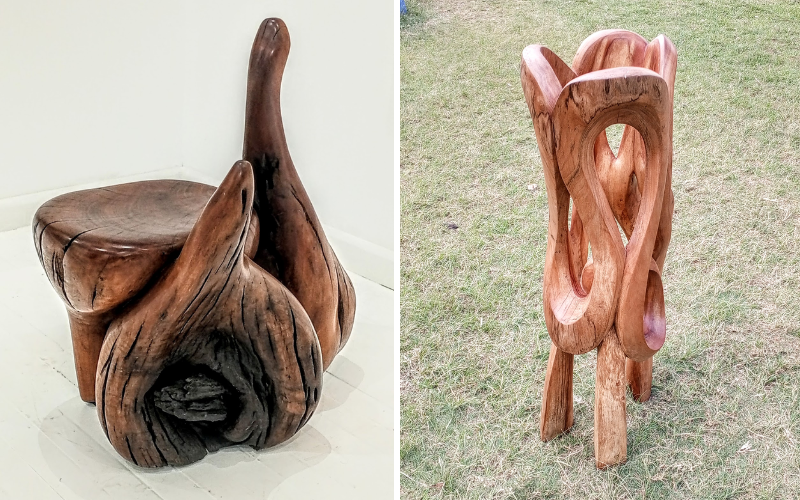
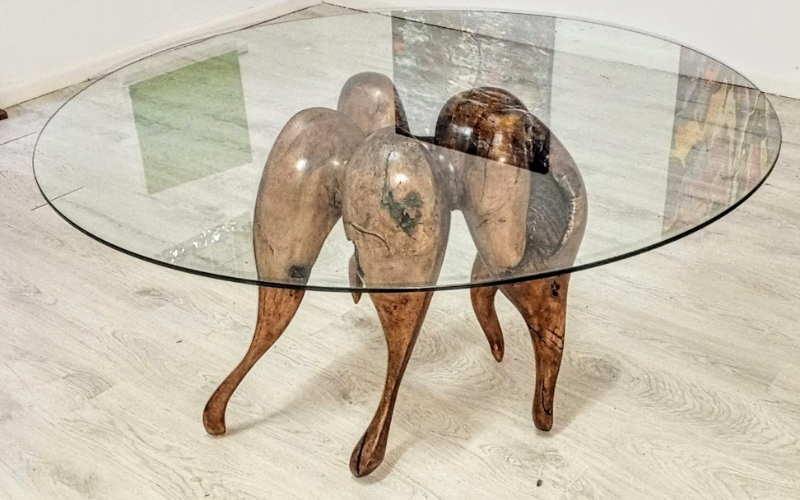
This is explored in his latest exhibition, titled Ancestral Grain, where he works with wood from fallen and removed trees to make three-dimensional functional pieces of furniture that are also sculptures. It is showing about 20 pieces: dining tables, coffee tables, benches, stools, and chairs.
Curated by Thadde Tewa of Tewasart and Patrons, it runs at the Rooftop Gallery, Village Market, from April 18 to May 6.


The exhibition title, Ancestral Grain, combines a tribute to people and traditions that have been here for generations but are forgotten, while grain is the natural pattern and texture of fibres in wood.
Kaigwa, who has worked with figurative sculpture in resin, fibreglass, stone, and metal for years, revisited his old sketches from as far back as the 1980s, when he was in his 30s, and asked himself why he was interested in how chairs and tables looked.
He was then inspired to trace childhood memories of traditional three-legged stools, which are part of a tradition that goes back centuries, and then reimagined what they would look like if they were brought to the future.
He continues their evolution as inherited knowledge that has been here for a long time and brings them to the present day as contemporary artworks.
Kaigwa sources his wood from roadside collectors who cut trees from homes and select pieces before they end up being charcoal and firewood. He works mainly with eucalyptus, cypress, jacaranda, and mango wood.
“I find mango wood fascinating because of the colour and shapes. It is a rich, earthy wood, from very light to very dark, and everything in between,” he says.
It is important to him that the wood isn’t randomly cut. It comes from a tree that was brought down by rain, for example, or a tree that just dried up.

“I give them a new life and purpose. It becomes a sort of beauty, and the spirit of the tree lives on in another form,” he says.
Before carving, he looks at the wood’s condition and grain. Since he is not a carpenter, he does not take different pieces of wood to make one sculpture. Instead, he creates functional forms such as coffee tables, benches, and chairs, each from a single piece of wood; therefore, they do not have joints.
After picking up a piece of wood, he sketches and carves into it while letting it guide him. The more he imposes on it, he says, the more it shows him what the wood itself wants.
“I’ll have a visual sense of what I want the piece to look like, and it ends up close to how I want it to be. I am flexible when some changes come along the way,” he says.

Kaigwa names pieces after places and animals based on their characteristics. An artwork titled Bogoria is a chair that has a spiral, while Tembo is a table that resembles an elephant.
While he won’t continue showing functional sculptures after Ancestral Grain, he hopes the exhibition changes how people relate to trees.
“We live in an age where we hear of people cutting down trees randomly, especially in the forest. Trees give us life. They need our respect,” he says.