



Audio By Vocalize
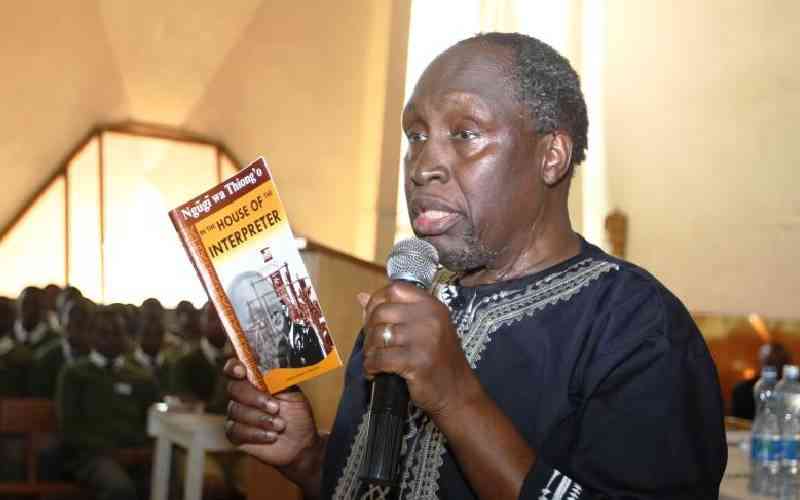
The late literary luminary Prof Ngugi wa Thiong’o, in a televised interview, once asserted that one who abandons their mother tongue in favour of a foreign language is, in essence, a slave.Language, he argued, is not merely a tool of communication but the vessel of thought, imagination, and cultural memory.
To forsake one’s first language is to sever the roots that nourish identity, to inhabit a world filtered through foreign eyes. In contrast, one who embraces their mother tongue while learning foreign languages stands empowered, capable of navigating multiple worlds without losing the depth of their own.
In a similar vein, the late Swahili literary scholar Prof Ken Walibora critiqued Kenyan school policies that seek to ban non-English languages. He recalled institutions that erect posters declaring, “This is an English-speaking zone,” effectively silencing the rich linguistic diversity that thrives beyond classroom walls. This prohibition extends beyond mere communication; it delegitimises the languages through which generations have encoded history, tradition, and identity.
Kiswahili, Kenya’s lingua franca, and indigenous languages such as Luhya, Kikuyu, Luo, Kalenjin and others are not only modes of expression but also repositories of literature, folklore and collective memory. Walibora highlighted the irony: a nation that celebrates cultural festivals, traditional music and oral storytelling simultaneously suppresses the very languages that sustain these practices.
One of Kenya’s few surviving cultural institutions, the Wanga Mukulu Kingdom under Nabongo Maurice Wambani Rapando, is enrolling students for Wanga language classes. This initiative is more than an act of cultural preservation; it is a deliberate assertion of identity.
Language, as both scholars observed, is inseparable from identity. When we silence a tongue, we silence a worldview. Our literature suffers, as stories rooted in local contexts are either lost in translation or never told at all. Our cultural heritage, once transmitted orally through proverbs, songs and folktales, risks extinction. More subtly, the ability to think critically in one’s mother tongue is diminished, for language shapes thought patterns, metaphors and cognitive frameworks.
Linguists and literary scholars have long argued that languages encode unique epistemologies; ways of knowing the world that cannot be fully translated into other tongues. The Luhya, for instance, possess proverbs that articulate social obligations and communal ethics in ways that English cannot adequately capture. Swahili idioms carry centuries of trade, migration and intercultural dialogue along the East African coast.
Celebrating one’s mother tongue is not synonymous with tribalism. Identity becomes tribal only when it is weaponised to diminish others. Being Luhya, Kikuyu, Luo or Maasai should signify belonging and cultural pride, not superiority. When cultivated alongside proficiency in global languages, mother tongues form the bedrock of intellectual dexterity, enabling individuals to navigate both local and global contexts with authenticity and confidence.
In Kenya today, a slow but notable revival of indigenous languages is underway. Cultural centres, local radio stations and even social media platforms increasingly produce content in mother tongues.
Support Independent Journalism
Stand With Bold Journalism.
Stand With The Standard.
Continue
→
Pay via
Secure Payment
Kenya’s most trusted newsroom since 1902
Follow The Standard
channel on WhatsApp
The late literary luminary Prof Ngugi wa Thiong’o, in a televised interview, once asserted that one who abandons their mother tongue in favour of a foreign language is, in essence, a slave.Language, he argued, is not merely a tool of communication but the vessel of thought, imagination, and cultural memory.
To forsake one’s first language is to sever the roots that nourish identity, to inhabit a world filtered through foreign eyes. In contrast, one who embraces their mother tongue while learning foreign languages stands empowered, capable of navigating multiple worlds without losing the depth of their own.
In a similar vein, the late Swahili literary scholar Prof Ken Walibora critiqued Kenyan school policies that seek to ban non-English languages. He recalled institutions that erect posters declaring, “This is an English-speaking zone,” effectively silencing the rich linguistic diversity that thrives beyond classroom walls. This prohibition extends beyond mere communication; it delegitimises the languages through which generations have encoded history, tradition, and identity.
Kiswahili, Kenya’s lingua franca, and indigenous languages such as Luhya, Kikuyu, Luo, Kalenjin and others are not only modes of expression but also repositories of literature, folklore and collective memory. Walibora highlighted the irony: a nation that celebrates cultural festivals, traditional music and oral storytelling simultaneously suppresses the very languages that sustain these practices.
One of Kenya’s few surviving cultural institutions, the Wanga Mukulu Kingdom under Nabongo Maurice Wambani Rapando, is enrolling students for Wanga language classes. This initiative is more than an act of cultural preservation; it is a deliberate assertion of identity.
Language, as both scholars observed, is inseparable from identity. When we silence a tongue, we silence a worldview. Our literature suffers, as stories rooted in local contexts are either lost in translation or never told at all. Our cultural heritage, once transmitted orally through proverbs, songs and folktales, risks extinction. More subtly, the ability to think critically in one’s mother tongue is diminished, for language shapes thought patterns, metaphors and cognitive frameworks.
Linguists and literary scholars have long argued that languages encode unique epistemologies; ways of knowing the world that cannot be fully translated into other tongues. The Luhya, for instance, possess proverbs that articulate social obligations and communal ethics in ways that English cannot adequately capture. Swahili idioms carry centuries of trade, migration and intercultural dialogue along the East African coast.
Celebrating one’s mother tongue is not synonymous with tribalism. Identity becomes tribal only when it is weaponised to diminish others. Being Luhya, Kikuyu, Luo or Maasai should signify belonging and cultural pride, not superiority. When cultivated alongside proficiency in global languages, mother tongues form the bedrock of intellectual dexterity, enabling individuals to navigate both local and global contexts with authenticity and confidence.
In Kenya today, a slow but notable revival of indigenous languages is underway. Cultural centres, local radio stations and even social media platforms increasingly produce content in mother tongues.
Follow The Standard
channel on WhatsApp
By Dennis Weche