

Audio By Vocalize
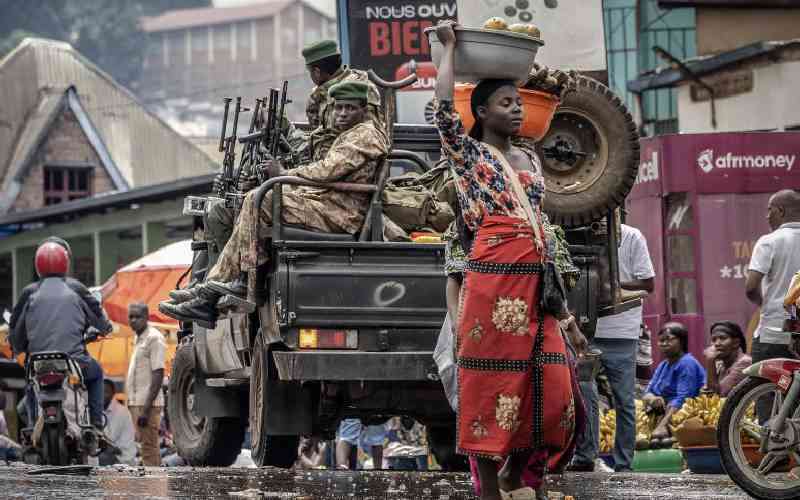
Members of the M23 armed group during a patrol following the takeover of Bukavu on February 18, 2025. [AFP]
Across several parts of Africa, insecurity has become a development crisis. From the Sahel to fragile borderlands and pastoralist regions, armed criminality is disrupting the foundations of daily life.
Communities are losing livestock, markets are shrinking, schools are closing, transport routes are becoming riskier, and families are being pushed deeper into poverty and displacement. In many of these places, insecurity is often a symptom of systems that have failed to create enough opportunity, enough inclusion, and enough hope for young people standing at the edge of the economy.
That is why Africa must resist the temptation to treat insecurity only as a policing problem.
Of course security responses remain necessary where lives are under immediate threat. When communities need protection, Governments must act decisively against violence and criminal networks, but force alone cannot rebuild trust, restore livelihoods, or create a future worth choosing. It may contain a crisis for a time, but it does not always remove the conditions that make instability attractive in the first place.
Where joblessness is high, education is weak, and social mobility feels out of reach, criminal and armed networks can offer something that formal systems have failed to provide: income, identity, structure, and belonging. This is especially dangerous for young people who feel abandoned by the state, overlooked by the market, and disconnected from pathways to dignity.
That is why the conversation about peace must expand.
The missing piece: Why skills matter
If Africa wants a more durable response to insecurity, it must invest in both deterrence and in development. And one of the most practical forms that development can take is skills.
Peace in the hands of a young person may look different from how policymakers often imagine it.
It may look like a solar toolkit instead of a weapon. A welding machine instead of unrest. A construction certificate instead of a life spent on the margins. It may look like a young person earning a lawful income, building something useful, and becoming visible again to the economy.
This is the promise behind the idea of skilling for peace.
At its core, skilling for peace is built on a simple belief: when young people are equipped with relevant, marketable skills and connected to real economic opportunity, they are more likely to invest in building their futures than in destroying the systems around them.
Skills do more than improve employability. They restore confidence, structure time, rebuild identity, and reconnect individuals to society through contribution rather than exclusion.
The case for this thinking is especially strong in Kenya.
In the country’s arid and semi-arid northern counties, insecurity often sits on top of long-standing economic and social exclusion. Poverty remains especially high in areas such as Turkana and Garissa. School participation continues to lag behind the national average in many arid regions, leaving too many children and young people outside the learning pathways. Insecurity then compounds these challenges by disrupting schooling, displacement, mobility, and local economic life.
Livestock rustling and armed violence in Kenya’s northern and north-rift counties are often discussed in terms of raids, conflict, and the loss of lives and property. But their impact is wider than the headlines suggest. They affect whether children can safely stay in school. They affect whether young people can travel for training or work. They affect whether businesses invest, whether teachers remain in post, and whether households have the confidence to plan beyond the next crisis.
In places where insecurity has displaced families and disrupted dozens of learning institutions, it becomes impossible to argue that peacebuilding should begin only after development arrives. Development in these instances should be seen as part of how peace is built.
This is where the renewable energy sector has a particularly important role to play.
Africa’s energy transition is often framed in terms of infrastructure, finance, and access. Yes, all of this matters, but the transition is also about livelihoods. Livelihoods in the sense of who gets trained, who gets hired, who gets included in new value chains, and whether the clean energy economy can become a source of both resilience and social stability.
This matters especially in underserved regions.
Some of the same areas struggling with poverty, exclusion, and insecurity are also places where off-grid and distributed energy solutions can transform local life. Mini-grids, standalone solar systems, solar-powered water pumping, productive-use appliances, rural electrification for health centres and schools, and energy for micro-enterprises are not abstract climate ambitions. They are practical development tools that can improve everyday life while opening up real work opportunities.
And these opportunities are not only for engineers with advanced degrees. They include solar installation and maintenance, electrical wiring, welding and fabrication, civil works, battery servicing, appliance repair, water systems support, productive-use equipment maintenance, and the digital and entrepreneurial services that grow around energy access.
These are exactly the kinds of practical, hands-on skills that can create visible alternatives for young people in fragile and underserved communities.
For this reason, skilling for peace should not be treated as separate from the green transition.
In many parts of Africa, the two agendas belong together.
How to make skilling for peace work: Five essential principles
When a young person learns to install a solar system, maintain a mini-grid, wire a workshop, repair productive-use equipment, or support a climate-smart construction project, that can be defined as a peace intervention.
It creates a lawful source of income, strengthens local services and links the individual to a growing sector. In turn, this turns development into something communities can actually see and feel. However, for this approach to work, skills programmes must be designed differently.
Too many training initiatives fail because they teach aspiration without teaching opportunity. Young people are trained in generic ways, then released back into economies with no demand for what they have learned. In fragile regions, that is both ineffective and can deepen frustration.
Training for peace must therefore be tied to real local demand.
In some places, that may mean solar installation and maintenance. In others, it may mean welding, construction, water systems, agribusiness support, or repair economies linked to rural productivity. The point is not to impose fashionable skills from above. The point is to build practical pathways rooted in what local communities and markets actually need.
The second requirement is reintegration.
Many young people in vulnerable settings do not come with neat educational histories. Some have dropped out of school. Some have learned informally through survival work or apprenticeship. Some may have been displaced, criminalized, or exposed to conflict. If systems only value conventional academic progression, they will miss exactly the people who most need a second chance.
That is why mechanisms such as Recognition of Prior Learning matter so much. They allow existing competencies to be assessed and acknowledged, regardless of where or how they were acquired. In peacebuilding terms, this is powerful. It says to a young person: your future does not have to start from zero. What you know can still count. Your skills can still be redirected. You can still re-enter the economy with dignity.
The third requirement is partnership.
Governments cannot do this alone. Technical and vocational institutions, private sector employers, local leaders, donors, and community-based organisations all have a role to play. Employers, in particular, should not stand at the edge of this conversation. They help define what skills are actually needed, what standards matter, and what pathways into work or enterprise can realistically be created. Without them, training risks becoming disconnected from jobs. With them, it can become a bridge to both productivity and stability.
Ultimately, skilling for peace is about restoring a social contract.
A trained solar technician, certified welder, or accredited construction worker is earning an income and becoming more visible to the formal economy, more connected to systems of value, and less vulnerable to the pull of violent alternatives. Thus we see skills creating a sense of competence and belonging.
The path Forward
If the continent is serious about long-term peace in vulnerable regions, it must widen the lens. It must respond to insecurity not only with enforcement, but with employability, with both patrols and pathways and with punishment alongside possibility.
Sometimes the most powerful peacebuilding tool is not a speech, a strategy document, or a summit, it is a skill that gives a young person a reason to choose a different future.
Anne Kamonjo is an education reformer and sustainability champion working at the intersection of policy, training, and systems change. She currently works at the Ministry of Education, State Department for TVET, leading Kenya’s national effort to institutionalize green skills across technical training institutions.
Support Independent Journalism
Stand With Bold Journalism.
Stand With The Standard.
Continue
→
Pay via
Secure Payment
Kenya’s most trusted newsroom since 1902
Follow The Standard
channel on WhatsApp
Members of the M23 armed group during a patrol following the takeover of Bukavu on February 18, 2025.
[AFP]
Across several parts of Africa, insecurity has become a development crisis. From the Sahel to fragile borderlands and pastoralist regions, armed criminality is disrupting the foundations of daily life.
Communities are losing livestock, markets are shrinking, schools are closing, transport routes are becoming riskier, and families are being pushed deeper into poverty and displacement. In many of these places, insecurity is often a symptom of systems that have failed to create enough opportunity, enough inclusion, and enough hope for young people standing at the edge of the economy.
That is why Africa must resist the temptation to treat insecurity only as a policing problem.
Of course security responses remain necessary where lives are under immediate threat. When communities need protection, Governments must act decisively against violence and criminal networks, but force alone cannot rebuild trust, restore livelihoods, or create a future worth choosing. It may contain a crisis for a time, but it does not always remove the conditions that make instability attractive in the first place.
Where joblessness is high, education is weak, and social mobility feels out of reach, criminal and armed networks can offer something that formal systems have failed to provide: income, identity, structure, and belonging. This is especially dangerous for young people who feel abandoned by the state, overlooked by the market, and disconnected from pathways to dignity.
That is why the conversation about peace must expand.
The missing piece: Why skills matter
If Africa wants a more durable response to insecurity, it must invest in both deterrence and in development. And one of the most practical forms that development can take is skills.
Peace in the hands of a young person may look different from how policymakers often imagine it.
It may look like a solar toolkit instead of a weapon. A welding machine instead of unrest. A construction certificate instead of a life spent on the margins. It may look like a young person earning a lawful income, building something useful, and becoming visible again to the economy.
This is the promise behind the idea of skilling for peace.
At its core, skilling for peace is built on a simple belief: when young people are equipped with relevant, marketable skills and connected to real economic opportunity, they are more likely to invest in building their futures than in destroying the systems around them.
Skills do more than improve employability. They restore confidence, structure time, rebuild identity, and reconnect individuals to society through contribution rather than exclusion.
The case for this thinking is especially strong in Kenya.
Stay informed. Subscribe to our newsletter
In the country’s arid and semi-arid northern counties, insecurity often sits on top of long-standing economic and social exclusion. Poverty remains especially high in areas such as Turkana and Garissa. School participation continues to lag behind the national average in many arid regions, leaving too many children and young people outside the learning pathways. Insecurity then compounds these challenges by disrupting schooling, displacement, mobility, and local economic life.
Livestock rustling and armed violence in Kenya’s northern and north-rift counties are often discussed in terms of raids, conflict, and the loss of lives and property. But their impact is wider than the headlines suggest. They affect whether children can safely stay in school. They affect whether young people can travel for training or work. They affect whether businesses invest, whether teachers remain in post, and whether households have the confidence to plan beyond the next crisis.
In places where insecurity has displaced families and disrupted dozens of learning institutions, it becomes impossible to argue that peacebuilding should begin only after development arrives. Development in these instances should be seen as part of how peace is built.
This is where the renewable energy sector has a particularly important role to play.
Africa’s energy transition is often framed in terms of infrastructure, finance, and access. Yes, all of this matters, but the transition is also about livelihoods. Livelihoods in the sense of who gets trained, who gets hired, who gets included in new value chains, and whether the clean energy economy can become a source of both resilience and social stability.
This matters especially in underserved regions.
Some of the same areas struggling with poverty, exclusion, and insecurity are also places where off-grid and distributed energy solutions can transform local life. Mini-grids, standalone solar systems, solar-powered water pumping, productive-use appliances, rural electrification for health centres and schools, and energy for micro-enterprises are not abstract climate ambitions. They are practical development tools that can improve everyday life while opening up real work opportunities.
And these opportunities are not only for engineers with advanced degrees. They include solar installation and maintenance, electrical wiring, welding and fabrication, civil works, battery servicing, appliance repair, water systems support, productive-use equipment maintenance, and the digital and entrepreneurial services that grow around energy access.
These are exactly the kinds of practical, hands-on skills that can create visible alternatives for young people in fragile and underserved communities.
For this reason, skilling for peace should not be treated as separate from the green transition.
In many parts of Africa, the two agendas belong together.
How to make skilling for peace work: Five essential principles
When a young person learns to install a solar system, maintain a mini-grid, wire a workshop, repair productive-use equipment, or support a climate-smart construction project, that can be defined as a peace intervention.
It creates a lawful source of income, strengthens local services and links the individual to a growing sector. In turn, this turns development into something communities can actually see and feel. However, for this approach to work, skills programmes must be designed differently.
Too many training initiatives fail because they teach aspiration without teaching opportunity. Young people are trained in generic ways, then released back into economies with no demand for what they have learned. In fragile regions, that is both ineffective and can deepen frustration.
Training for peace must therefore be tied to real local demand.
In some places, that may mean solar installation and maintenance. In others, it may mean welding, construction, water systems, agribusiness support, or repair economies linked to rural productivity. The point is not to impose fashionable skills from above. The point is to build practical pathways rooted in what local communities and markets actually need.
The second requirement is reintegration.
Many young people in vulnerable settings do not come with neat educational histories. Some have dropped out of school. Some have learned informally through survival work or apprenticeship. Some may have been displaced, criminalized, or exposed to conflict. If systems only value conventional academic progression, they will miss exactly the people who most need a second chance.
That is why mechanisms such as Recognition of Prior Learning matter so much. They allow existing competencies to be assessed and acknowledged, regardless of where or how they were acquired. In peacebuilding terms, this is powerful. It says to a young person: your future does not have to start from zero. What you know can still count. Your skills can still be redirected. You can still re-enter the economy with dignity.
The third requirement is partnership.
Governments cannot do this alone. Technical and vocational institutions, private sector employers, local leaders, donors, and community-based organisations all have a role to play. Employers, in particular, should not stand at the edge of this conversation. They help define what skills are actually needed, what standards matter, and what pathways into work or enterprise can realistically be created. Without them, training risks becoming disconnected from jobs. With them, it can become a bridge to both productivity and stability.
Ultimately, skilling for peace is about restoring a social contract.
A trained solar technician, certified welder, or accredited construction worker is earning an income and becoming more visible to the formal economy, more connected to systems of value, and less vulnerable to the pull of violent alternatives. Thus we see skills creating a sense of competence and belonging.
The path Forward
If the continent is serious about long-term peace in vulnerable regions, it must widen the lens. It must respond to insecurity not only with enforcement, but with employability, with both patrols and pathways and with punishment alongside possibility.
Sometimes the most powerful peacebuilding tool is not a speech, a strategy document, or a summit, it is a skill that gives a young person a reason to choose a different future.
Anne Kamonjo is an education reformer and sustainability champion working at the intersection of policy, training, and systems change. She currently works at the Ministry of Education, State Department for TVET, leading Kenya’s national effort to institutionalize green skills across technical training institutions.
Follow The Standard
channel on WhatsApp
By Anne Kamonjo