


Audio By Vocalize
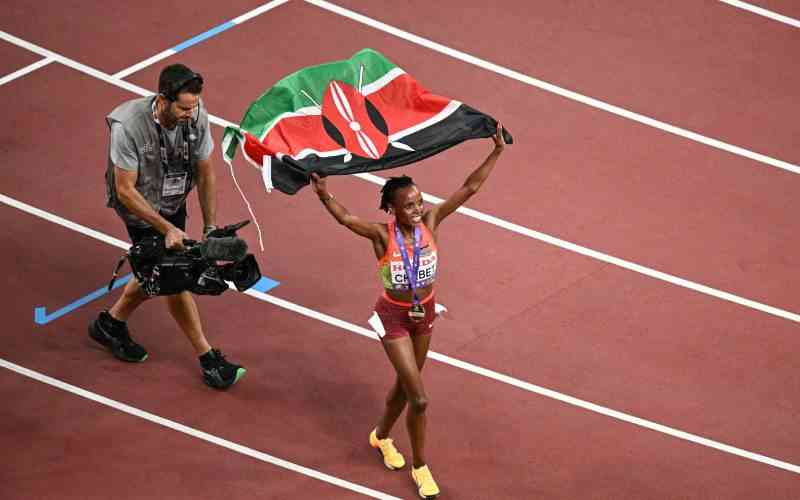
Beatrice Chebet celebrates after winning the women’s 10000m final during the World Athletics Championships in Tokyo on September 13, 2025. [AFP]
Kenya is a country that produces world champions. From the Rift Valley come runners who have dominated the global stage for decades. The country of 55 million has, at various points, been simultaneously the best on the track, the road and cross country.
Kenya has never produced a professional tennis player of international standing. It has never won a medal in cycling, rowing, equestrian, or sailing at a major international games.
If the talent is as deep as the athletics results suggest, the absence of champions in these other disciplines demands an explanation. The explanation is not physiological. It is not cultural in any deep or inevitable sense. It is economic, structural, and built into the school system that serves as the primary gateway to organised competitive sport in this country.
The invisible ceiling is not a mystery. It is a postcode.
The sports that produce Olympic medals in wealthy nations, tennis, swimming, rowing, equestrian, sailing, and golf, are almost exclusively available at private schools and elite academies in Nairobi’s most affluent neighbourhoods.
The institutions charging school fees in the hundreds of thousands per term have multi-court tennis facilities, swimming pools, stables, and professional coaching infrastructure that convert a talented 12-year-old into a competitive prospect.
A child growing up in Kisumu, Meru, Eldoret, or any of the 290 constituencies outside Nairobi’s wealthy satellite zones almost certainly has access to a football pitch or an athletics track. That same child almost certainly does not grow up with access to a regulation tennis court, a competitive swimming pool, or a coach qualified to teach the technical foundations of any Olympic discipline that requires specialist infrastructure to begin.
Private schools produce Olympic athletes at dramatically disproportionate rates, not because of any innate superiority in the children but because of the structured, clear pathways and quality coaching they provide, including on-site nutritionists, physiotherapists, and academic calendars built around competitive training schedules.
The talent is distributed across the population. The infrastructure is not. In sports where you cannot develop fundamental technical skills without specific facilities during childhood, the potential champion stays in government school, and the discipline that could have defined their career remains structurally invisible to them.
In equestrian, rowing, sailing, tennis, and swimming, privately educated athletes consistently account for a disproportionate share of national Olympic squads in countries that track such data. The pattern reflects not the quality of athletes from state schools but the quality of access to them. Athletics and football require open ground and a ball.
Olympic swimming requires a pool. Olympic tennis requires a court, a qualified coach, and years of technical instruction before a child can compete in a match. None of that is available in most of Kenya, and because it is not available, the children who might have become world-class swimmers or tennis players become runners instead, or they do not become competitive athletes at all.
The consequences extend beyond the medal table. Every year that Kenya does not invest in technical Olympic infrastructure in public schools is a year in which the country silently decides that certain sports belong to certain children, which is another way of saying that certain futures belong to certain families. That is not a sporting problem. It is a social one in which sport is used to obscure.
Kenya’s school sports system runs competitions across multiple disciplines, including tennis and swimming. Those competitions exist. The problem is what happens before them, the years of early development and specialist coaching that separate a child who arrives with foundations from one who arrives with only enthusiasm. Government schools are routinely eliminated by private institutions whose students have been receiving professional coaching since primary school.
Kenya will arrive at the 2028 Los Angeles Olympics with its usual world-class distance runners. The athletics hall will see Kenyan flags raised and Kenyan anthems played, as it has for the past six decades. Somewhere in the aquatics centre, a swimmer from a country with a fraction of Kenya’s athletic depth will collect a medal that a Kenyan child could have won if they had ever been given access to a pool.
The talent was always there. The ceiling was in the way.
Koome Kazungu is a strategic communications expert