

Audio By Vocalize
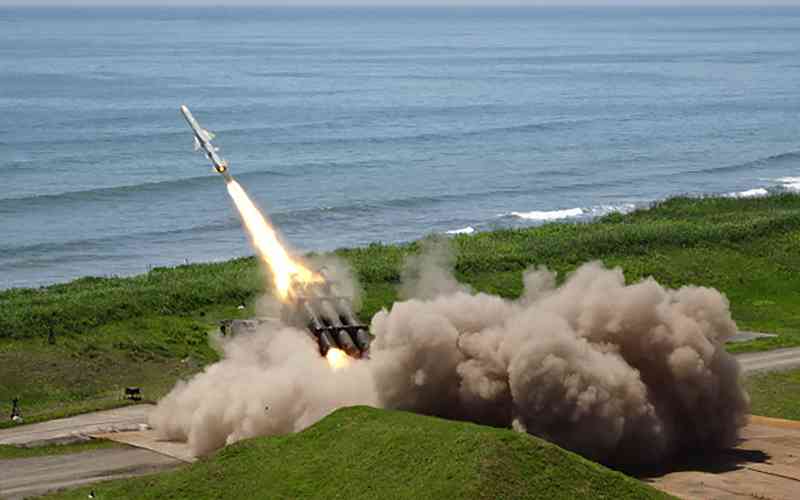
A single “Type-88” missile being tested off the coast at the JGSDF Shizunai Anti-aircraft firing range in Shinhidaka, Hidaka district on the northern island of Hokkaido, on June 24, 2025. [AFP]
Japan will ease decades-old arms export rules, the government’s top spokesman Minoru Kihara said on Tuesday, a policy shift that paves the way for the sale of lethal weapons overseas.
The new rules end Japan’s self-imposed curb on sales of lethal arms as Tokyo seeks to enter the international arms market, hoping to bolster national defence as well as boost economic growth.
It comes as anxiety increases over China’s escalating military activity in the region, as well as persistent security threats from North Korea and Russia.
“These decisions have been made at a time when changes in the security environment surrounding our country are occurring at an accelerating pace, and they serve to ensure Japan’s security while contributing even more to peace and stability in the region and the international community,” Kihara told a news conference.
“Today, no nation can safeguard its own peace and security by itself alone.”
Exports had previously been limited to equipment classified under five categories: search and rescue, transportation, warning, surveillance and minesweeping.
However, Prime Minister Sanae Takaichi posted on X that “with this amendment, transfers of all defence equipment will in principle become possible”.
Proponents of the policy shift argue that the change should further integrate Tokyo in the international defence supply chain, deepening defence, diplomatic and economic ties with partner nations as regional instability grows.
But the decision has caused unease among some members of the Japanese public, with critics accusing Takaichi of eroding the proud history of the nation’s staunch pacifism.
The policy change has been approved by the Cabinet and the National Security Council, Kihara said.
Heigo Sato, an expert on defence issues and arms control at Takushoku University, said Japan must use this time of peace to ensure combat readiness by establishing “a system that ensures the smooth exchange of weapons and ammunition” between allies.
He told AFP that exports require routine maintenance, providing defence contractors with steady business while also strengthening ties with buyer nations.
By making the arms trade a two-way exchange, Japan might improve the chances of receiving help from allies in the event of an unexpected, prolonged conflict, he said.
The new rules are part of an incremental easing of the blanket export ban on weapons that was first introduced in 1976.
Takaichi said export “recipients will be limited to countries that pledge to use the equipment in a manner consistent with the United Nations Charter”.
“There is absolutely no change in our commitment to the path and fundamental principles we have followed for more than 80 years as a pacifist nation since the end of the war,” she said, referring to World War II.
However, the Japanese public appears uneasy about the prospect of exporting lethal arms.
A March survey by national broadcaster NHK showed that 53 percent of participants opposed the step, while only 32 percent supported it.
Peace activists have staged rallies across the nation over concerns that Takaichi’s hawkish world views and open support for US President Donald Trump could drag Japan into conflicts. Some appeared to be protesting against the easing of arms export rules.
Veteran activist Koji Sugihara warned that the change was “a historic turning point”, arguing that Japan’s pacifist reputation has historically aided its diplomatic and business relations.
“People do not want Japanese-made products to be used to kill people in foreign countries,” Sugihara said.
Japan previously exported bullets and military supplies to boost its economy, particularly during the Korean War in the 1950s, but adopted a conditional weapons export ban in 1967 before a total bar came in a decade later.
Tokyo has made exceptions to the rules in recent decades, especially when joining international weapons development projects, before it opened the door to exports in 2014 in the five non-lethal military product categories.
Five Japanese firms — Mitsubishi Heavy Industries, NEC, Kawasaki Heavy Industries, Mitsubishi Electric and Fujitsu are among the world’s top 100 arms companies, according to data from the Stockholm International Peace Research Institute.
Support Independent Journalism
Stand With Bold Journalism.
Stand With The Standard.
Continue
→
Pay via
Secure Payment
Kenya’s most trusted newsroom since 1902
Follow The Standard on
A single “Type-88” missile being tested off the coast at the JGSDF Shizunai Anti-aircraft firing range in Shinhidaka, Hidaka district on the northern island of Hokkaido, on June 24, 2025.
[AFP]
Japan will ease decades-old arms export rules, the government’s top spokesman Minoru Kihara said on Tuesday, a policy shift that paves the way for the sale of lethal weapons overseas.
The new rules end Japan’s self-imposed curb on sales of lethal arms as Tokyo seeks to enter the international arms market, hoping to bolster national defence as well as boost economic growth.
It comes as anxiety increases over China’s escalating military activity in the region, as well as persistent security threats from North Korea and Russia.
“These decisions have been made at a time when changes in the security environment surrounding our country are occurring at an accelerating pace, and they serve to ensure Japan’s security while contributing even more to peace and stability in the region and the international community,” Kihara told a news conference.
“Today, no nation can safeguard its own peace and security by itself alone.”
Exports had previously been limited to equipment classified under five categories: search and rescue, transportation, warning, surveillance and minesweeping.
However, Prime Minister Sanae Takaichi posted on X that “with this amendment, transfers of all defence equipment will in principle become possible”.
Proponents of the policy shift argue that the change should further integrate Tokyo in the international defence supply chain, deepening defence, diplomatic and economic ties with partner nations as regional instability grows.
But the decision has caused unease among some members of the Japanese public, with critics accusing Takaichi of eroding the proud history of the nation’s staunch pacifism.
The policy change has been approved by the Cabinet and the National Security Council, Kihara said.
Heigo Sato, an expert on defence issues and arms control at Takushoku University, said Japan must use this time of peace to ensure combat readiness by establishing “a system that ensures the smooth exchange of weapons and ammunition” between allies.
He told AFP that exports require routine maintenance, providing defence contractors with steady business while also strengthening ties with buyer nations.
By making the arms trade a two-way exchange, Japan might improve the chances of receiving help from allies in the event of an unexpected, prolonged conflict, he said.
The new rules are part of an incremental easing of the blanket export ban on weapons that was first introduced in 1976.
Stay informed. Subscribe to our newsletter
Takaichi said export “recipients will be limited to countries that pledge to use the equipment in a manner consistent with the United Nations Charter”.
“There is absolutely no change in our commitment to the path and fundamental principles we have followed for more than 80 years as a pacifist nation since the end of the war,” she said, referring to World War II.
However, the Japanese public appears uneasy about the prospect of exporting lethal arms.
A March survey by national broadcaster NHK showed that 53 percent of participants opposed the step, while only 32 percent supported it.
Peace activists have staged rallies across the nation over concerns that Takaichi’s hawkish world views and open support for US President Donald Trump could drag Japan into conflicts. Some appeared to be protesting against the easing of arms export rules.
Veteran activist Koji Sugihara warned that the change was “a historic turning point”, arguing that Japan’s pacifist reputation has historically aided its diplomatic and business relations.
“People do not want Japanese-made products to be used to kill people in foreign countries,” Sugihara said.
Japan previously exported bullets and military supplies to boost its economy, particularly during the Korean War in the 1950s, but adopted a conditional weapons export ban in 1967 before a total bar came in a decade later.
Tokyo has made exceptions to the rules in recent decades, especially when joining international weapons development projects, before it opened the door to exports in 2014 in the five non-lethal military product categories.
Five Japanese firms — Mitsubishi Heavy Industries, NEC, Kawasaki Heavy Industries, Mitsubishi Electric and Fujitsu are among the world’s top 100 arms companies, according to data from the Stockholm International Peace Research Institute.
By AFP