



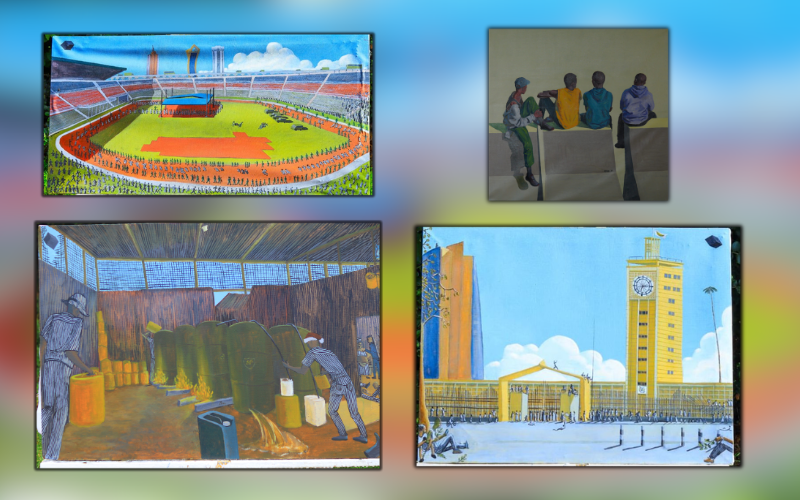
A duo exhibition titled Chorus of Beings by Paul Njihia and Newton Eshivachi explores figurative paintings that depict the dynamics of multiple human beings together in everyday spaces. Curated by seasoned painter Thom Ogonga, it will run from April 25 to May 24 at One Off Art Gallery.
Ogonga explains that the exhibition looks at how people exist and leave traces in the spaces they pass through; thus, they interact not as solo beings but as a chorus. The figures are people in public and temporary places connected through everyday interaction, proximity, and distance, with different postures and spatial arrangements.
In these settings, the artists capture the movements of daily life while exploring contrasts between visibility and invisibility, presence and absence.
“Bodies dissolve, overlap, and fragment, suggesting the instability of identity and the porous boundaries between self and other,” says Ogonga.
Njihia’s Nairobi Sisi TV is a series of works featuring people going about their daily activities, viewed from an aerial view. Influenced by the constant gaze of overhead cameras, the paintings examine power dynamics found in everyday life.


As CCTV systems become more common in streets, workplaces, and public spaces, their role is for security and surveillance, controlled by those in power over those below.
The aerial viewpoint represents this imbalance of people who are visible while those watching are unseen. Njihia’s work shows the conflicts between protection and policing, visibility and invisibility, and freedom and control and asks viewers to adopt the perspective of the camera lens while simultaneously questioning its authority.
“The idea for the series came after the installation of CCTV cameras in Nairobi through a government partnership with a telecommunications company. This led me to think about how people are viewed from the surveillance angle of CCTV cameras,” Njihia says.
He adds that he pays attention to posture and dressing when portraying figures in public settings because they reveal information without relying on facial expressions.

While creating this body of work, his main focus was building a sense of place through colour and shadows, and he works with both oil and acrylic paint.
“In terms of technique, I love using flat colours next to textured strokes. This creates an interesting contrast visually,” he says.
Eshivachi approaches his work centred on metamodern thought that portrays the conflict between reality and what it should have been.
Working primarily with acrylic on canvas, Eshivachi employs the artistic style of critical realism to probe contemporary African societies: the socio-cultural, economic and political structures that produce conditions and behaviours.
He said he approached the title by visiting places where many people gather to take part in a collective act. Empathy is what pulls him to everyday moments.
“When I go to a place and I am touched, I want to explore that in my work,” he said.
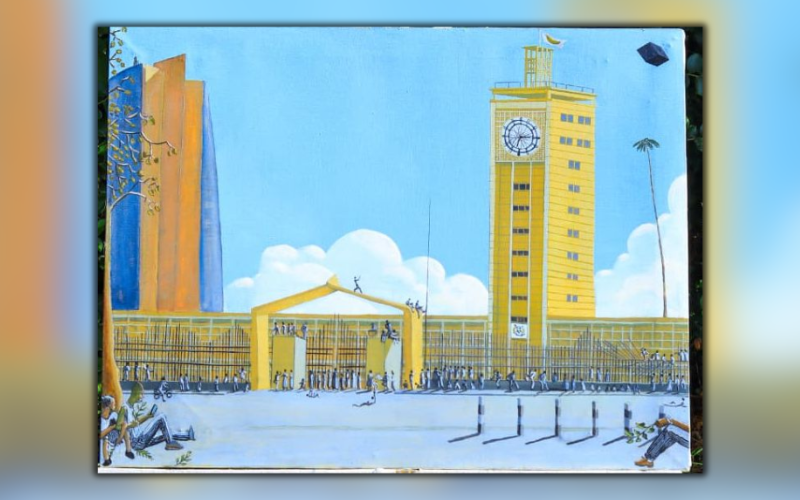
A painting titled State Funeral at Nyayo Stadium was inspired by crowds gathered during Raila Odinga’s state funeral. Another work, Mourners Waiting, captures mourners outside Parliament standing in different places and on fences.
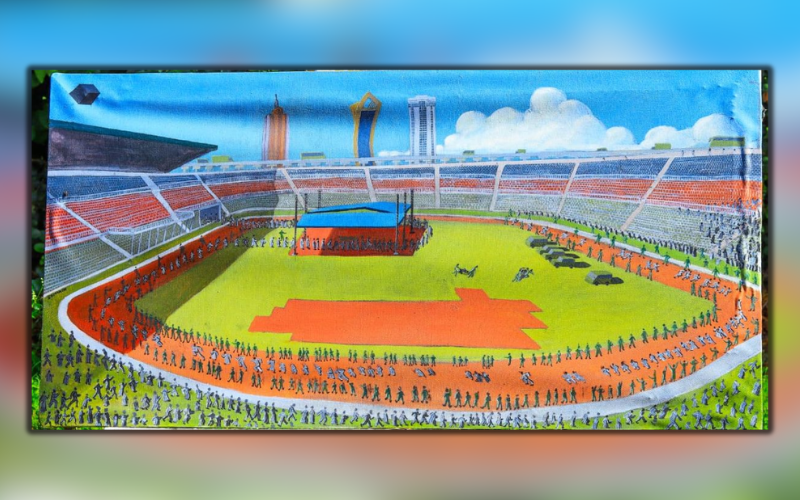
“People came from different areas for the funeral, and by them being there, their lives intersected. It shows the chaos during that day between the public and the police service,” he explains.
In a piece titled Queen Victoria at Bunge la Wananchi, he explores how people meet at Jevanjee Gardens in Nairobi to discuss politics with the statue of Queen Victoria just there. While the statue was destroyed, he included it in his piece to question whether public conversations can bring change in a society still affected by neocolonialism.
“The piece questions whether local politics and participation can influence the larger scheme of things. I learned that we cannot vote out neocolonialism. Even as we discuss local politics to replace corrupt leaders, we still have neocolonialism in our midst,” he says.
Another piece, Influx, shows imported mitumba clothes and informal traders carrying bales into a warehouse.

The mitumba clothes represent new ideas that people adopt when they wear them. He invites viewers to ask what else is in flux when they come into the country.
His use of prison uniforms in many of his paintings is to show the clash between the control of systems of governance and personal freedom.
“The body of work is a continuation of the previous work, and it is more focused on people, how people interact and the spaces that they inhabit. It is like a chorus,” he says.