



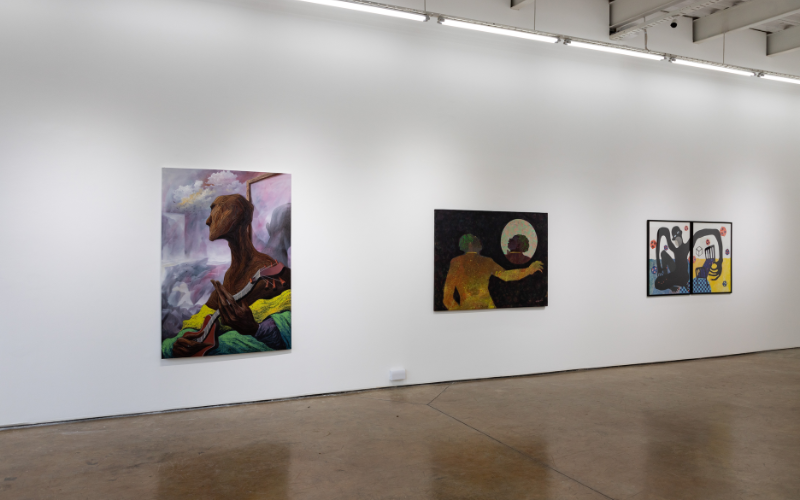
Three seasoned artists and founders of the Brush Tu Artist Collective come together for the first time in Handle with Care at the Circle Art Gallery.
Running from April 22 to May 29, the trio exhibition brings together Boniface Maina, David Thuku, and Michael Musyoka after long years of individual practice and managing Brush Tu. It features 22 artworks that explore human experience across social, spiritual, figurative, and psychological dimensions.
Boniface Maina


Working predominantly in painting and drawing, Maina explores the inconsistencies and conflicts of human interaction in physical space. His works are distorted, exaggerated figures constructed through dense, interwoven lines that give a muscular appearance.
Although the artists explore the human figure, he notes that they approach it differently.
“The common subject in the trio is the human figure. That being the common carrier of the message, I felt that each of us would bring it out in our own unique way, hence personalising our approaches,” Maina says.

He tackled the exhibition theme by defining care as observing thin boundaries employed in individual and societal contexts and knowing when and how to cross them.
His starting point was an interest in glass as an object that everyone interacts with and how it changes in meaning through use: its fragility and solidity, crudeness and gentleness, clarity and reflection, and its ability to obscure or protect.
In A Personal Playlist, a figure meticulously composed of wood-like fibres plays a stringed instrument against a dreamy, cloud-filled backdrop.
David Thuku

Thuku’s papercut artwork titled Untitled (Lay III) Polyptych is split across four separate frames. It shows a dark elongated figure lying down, the body broken up by gaps between the frames, with a blue strip running in the background.
He describes his process as delicate and forceful, reflecting the conflicts in human relationships.
“My process is very intricate, yet brutal on the material. Using sharp objects on paper becomes symbolic of how sensitive human relations can be. If not handled with care, it easily breaks,” he says.
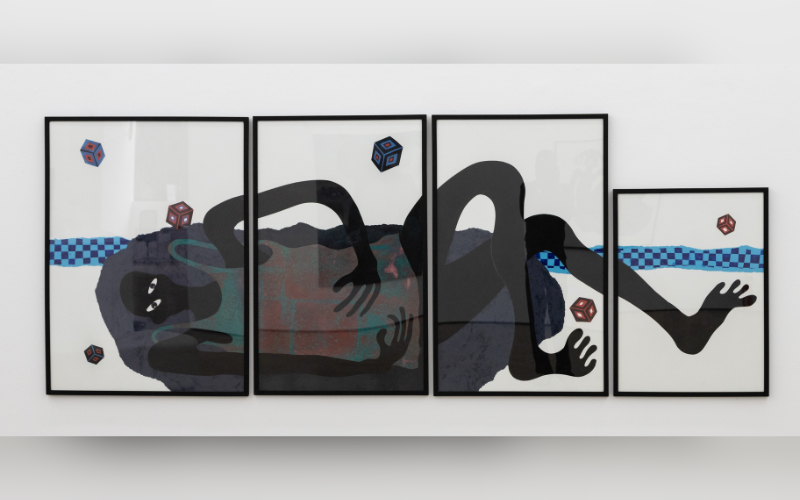
Thuku has worked with paper for years, presenting his first body of work in 2015. Through selected sheets, he builds images by adding and removing material to reveal constructed forms beneath the surface.
His current works are semi-abstract portraits marked by distinctive clothing and postures, engaging themes of consumerism, corruption, domestic life, personal decision-making, social structures, urban migration, and identity.
He adds that the exhibition theme emerged only after the works were completed independently.
“The theme came as a finishing point. We worked separately, trusting each other; the theme came about only after the works were completed,” Thuku says.
Michael Musyoka

Musyoka’s paintings feature a recurring clown figure and interrogate the contradiction between inner truth and outward behaviour. In Scapegoat, he creates a hazy, impressionistic scene depicting a dense gathering of people under golden light, layered with vibrant red speckles.
While the three artists discussed how to reconcile their different disciplines, Maina admits the most difficult aspect was bringing their long individual practices into a single show. A group exhibition, he notes, requires balancing distinct voices so they are heard both individually and in unison.
“The hardest part is ensuring one is not the loudest elephant in the room. This has been a keen focus for me in such a way that my work speaks in unison without necessarily being loud,” Maina says.

Although the idea of working together has been discussed for the past decade, the artists needed time to grow through their practice, making the collaboration more meaningful.
“To me, it shows a connection in perspectives of life’s journey through our individual lenses of practice. It is a solid proof of skills and ideologies that brought us together to start a collective,” Maina says.
Thuku reflects that the process was shaped by shared studio culture, conversation, long-standing trust, and ongoing exchange.
“This shows that despite different techniques, our works still complement each other. We always talk about being honest in our practice and sharing experiences. That keeps us grounded,” he says.
He views the collaboration as a matter of timing and coordination, noting that working alongside Maina and Musyoka continues to influence his thinking.
“There is always an urge to push limits. That aligns with my creative process and gives me a sense of creative balance. I see this as a threshold, a stage that allows me to continue embracing collaboration and growth,” he says.
Similarly, Maina sees a shift in contemporary art, where collaboration among established artists is becoming more viable.
“It shows that what was deemed impossible is actually achievable in our contemporary space, no matter the geological background one has come from,” he says.