

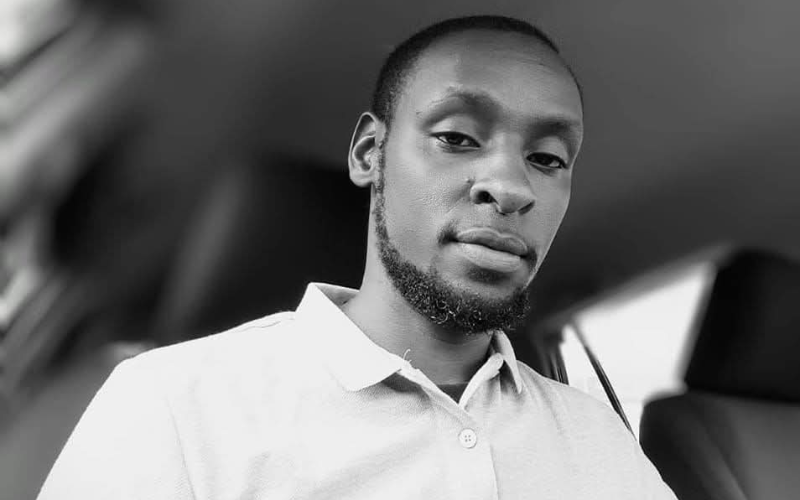
A story centered on a transgender black man taking over the Vatican as pope, one of the world’s most powerful and sacred institutions, has made Kenyan writer Owen Habel Lwanda one of the five shortlisted writers for the Afritondo Short Story Prize 2026.
Lwanda received the nod for The Sun of God, a bold short story that explores religion and identity through the experience of a Kenyan man, Lior, trying to fit into a place that was never built for him.
This year’s Afritondo Short Story Prize attracted more than 760 entries from over 40 countries, and the winner will be announced in May. Despite this, Lwanda says he was not surprised to see his story make the final shortlist.
“To be very honest, I wasn’t shocked. I would be shocked if I missed the shortlist,” he says.
The confidence comes from a writer who enjoys crafting stories that unsettle readers and push boundaries into uncomfortable terrain, and The Sun of God is no exception.
He says the story aligned with this year’s theme of transition, a subject that instantly appealed to him. H“While the storyline sounds controversial, it is actually a meditative piece,” he says.
Lwanda says he started with the competition theme and then developed the story around what he understood to be Afritondo’s literary identity. He studied previous Afritondo winners and finalists to understand the kind of fiction the prize had historically embraced.
From those readings, he noticed every winning piece revolved around an African who ventured out into the world. While judges change from year to year, he believes the prize itself has developed a recognisable signature.
“There is a type of writing that would work for one prize and not for Afritondo,” he notes.
He also read works by two of the current judges – Drinking from Graveyard Wells by Yvette Lisa Ndlovu and The Silent Striker by Pete Kalu – to better understand the kinds of stories they might naturally gravitate toward. Originally, the protagonist of The Sun of God was imagined as a white man. But when the Afritondo theme was announced, Lwanda reimagined Lior’s character as a transgender Kenyan man from Limuru who joins the Catholic Church seeking peace, then rises through its ranks to become pope at the Vatican.
“When I saw the theme, I said, ‘Why not make this person a Kenyan from Limuru?’ Lior is a Hebrew word meaning ‘sun’ and was chosen for its symbolism while avoiding unnecessary offence or stereotype,” he says.
Though the competition theme was one, he wanted to interpret it extensively. He says the story explores transition on multiple levels: institutional, psychological, physical, gendered, spiritual and geographical.
For all the story’s imaginative ambition, Lwanda says one of the hardest parts of writing it was research.
“You don’t bump into information about the Vatican that easily. To better understand Catholic doctrine and institutional structures on how one ascends to be a pope, I consulted a priest,” he says.
He says he valued the creative freedom the competition offered. In contrast to restrictive youth-focused spaces such as school drama festivals, where he pens stage plays and themes are narrow and socially prescribed, he says Afritondo gave him room to address subjects avoided in public conversation.
“Afritondo gave me room to write about things that aren’t talked about in public. The shortlist confirms to me that difficult, provocative fiction still has room in contemporary African literary spaces,” he says.
After the shortlist recognition, he says he hopes to continue writing stories that challenge systems.
“I want to continue writing stories that delve into uncomfortable spaces where identity, belief and power intersect. I hope readers will get access to my voice,” he says.