



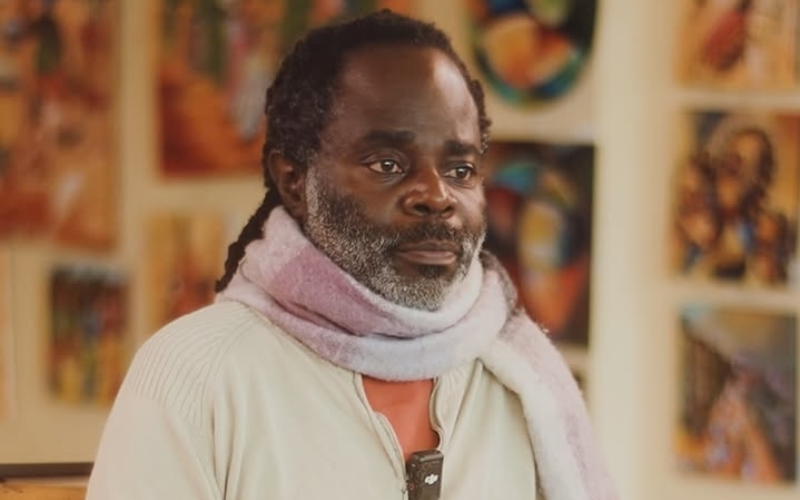
Legendary painter Patrick Mukabi, fondly known as Panye, has died at 56 after illness, leaving behind a vibrant legacy of art and mentorship that shaped a generation of creatives.
Celebrated for his bold, colourful works and everyday storytelling, Mukabi was also known for his warmth and generosity to young artists.
Born in Nairobi in 1969 as the fourth of seven children, he began drawing early, inspired by Catholic imagery and encouraged by his father, a Kenya Railways employee.
He later studied graphic design at what is now the Technical University of Kenya before returning to his true passion that is fine art.
Mukabi’s work is widely recognised, displayed in Java House outlets, homes, and public spaces such as Jomo Kenyatta International Airport, and exhibited in over 20 countries.
In his later years, he developed the Cover Girls series celebrating curvy women outside conventional beauty standards, reflecting his belief in everyday beauty, confidence, and strength.
He also worked in major art spaces including the Nairobi National Museum, Kuona Artists Collective, GoDown Arts Centre, and the Railway Museum. At Dust Depo Studio, he built a welcoming space for learning and creation, mentoring many young artists who credit him for shaping both their practice and understanding of the art business.
Artist Jimmy Kitheka, a protégé of Patrick Mukabi, recalls meeting the veteran painter in 2014 and later joining him at Dust Depo studio alongside other artists under his mentorship.
He says Mukabi welcomed him warmly and allowed him to work freely in the studio, a moment that changed his outlook on art.
“That’s when I realised art was also a business,” Kitheka says, adding that Mukabi’s constant activity inspired discipline.
Beyond technique, Mukabi taught practical studio skills like priming canvases and also supported young artists personally. Kitheka describes him as widely respected and well known even to parents, noting his strong connection with people.
The studio was a busy creative hub where artists planned exhibitions, art shows, created pieces, and taught children’s art classes. It also attracted buyers who came to interact with artists and purchase works.
Kitheka says the studio at the Railway Museum was eventually closed after a change in management, forcing artists to relocate. He later opened a studio in Karen, where Mukabi briefly joined before setting up his own space at T-Mall.
“He was always working, always teaching, always interacting with students and visitors,” he says.
He describes Mukabi as a versatile artist working in charcoal, oils, acrylics, and sculpture, noting that Dust Depo became a key hub for local and visiting creatives. Kitheka also credits him with shaping his practice, from improving materials to refining technique.


Their long-discussed collaboration later materialised in the Dust to Form exhibition at Ardhi Gallery in May 2025, honouring mentorship and artistic lineage through charcoal.
Even as he battled illness, fellow artists organised exhibitions to support his medical care. In April 2026, the Patrick Mukabi Medical Fund Benefit Art Exhibition was held at Trademark Hotel, Village Market, and brought together 47 artists who donated 50 works to support his medical care. The initiative was curated by Thadde Tewa through Tewasart and Patrons.
The Banana Hill Art Gallery has also been running his solo exhibition titled Mali Safi from March 21 to May 5 to raise funds for his medical care. Some of the works in this exhibition were borrowed from collectors to fill the gallery walls since Mukabi was unable to produce new works.
Mukabi is affectionately remembered for mentoring countless emerging artists throughout his career at his studios, and whenever artists bumped into him in artistic spaces, he always offered good cheer, advice and encouragement.
Eric Muriithi, artistically known as Stickky, is another one of Mukabi’s mentees at Mukabi’s Dust Depo Studio who paid tribute to him.
“The world has lost a great man, a kind, gentle soul, talented beyond measure and a father figure to so many artists. May he rest well … and may his wonderful talks be told for ages. Rest well, Panye,” he wrote on Facebook.
Kids Create Kenya remembered Mukabi’s time at Anidan Art Centre 11 years ago, where he mentored young artists in foundational techniques and where he taught perspective drawing and experimental charcoal techniques.
“Patrick was an inspiration and teacher to so many young artists in Kenya; his passion, dedication and creative techniques can still be felt in the artworks of the young artists there,” they wrote on Instagram.
They continued: “If you look closely enough, you can still see his hand in hundreds of paintings created by Kenyan artists working today.”
Kitheka, also a teacher of the visual arts, remembers Mukabi for teaching with a lot of passion.
“Currently, I am teaching, and I want to emulate the same: to show people the way and be kind-hearted when showing people the way. He was fun and good to everyone,” Kitheka says.
Curator and artist Stephanie Chianda said Mukabi’s studio had become an important place for many artists at the start of their careers.
“Every artist I know personally has a Panye story of how his studio was a place of mentorship and grounding in his early art career. This is a big loss,” she says.