

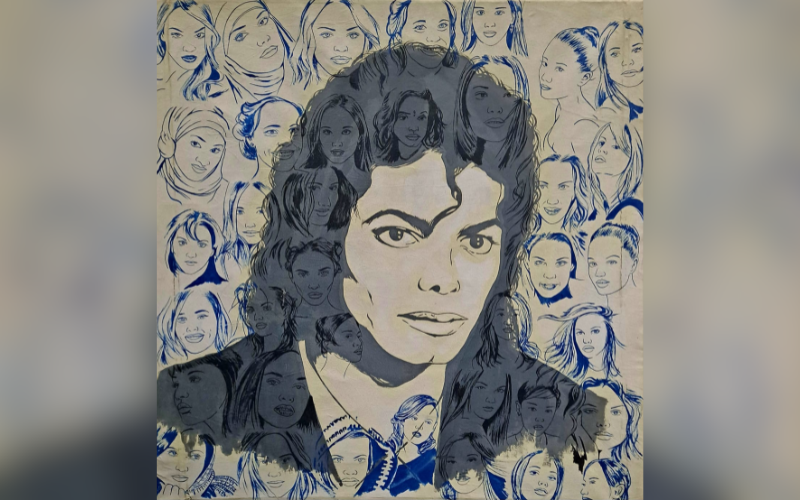
As Michael Jackson’s film titled Michael premiered globally, Kisumu artist Oliver Okoth opened Man in the Mirror, an exhibition of paintings celebrating the late pop icon for his lasting influence on music and image.
Curated by Julia Ekong and Jimmy Ogonga, the exhibition was showing at Vic Hotel, located next to the Kisumu movie theatre, where Michael’s film has been screening.
The show ran from April 24 to 26 and offered audiences a chance to engage with a solo exhibition centred on him as cinema lovers watched his story on screen.

“The whole world is celebrating him right now. I hoped we could do the same catch on the global trend; it can be nice to be part of the celebration for the people,” he explains.
The exhibition showcases 23 paintings selected from an original 40-piece body of work first shown in 2017 under the title Thriller at the Nairobi National Museum.
The exhibition title was inspired by Jackson’s hit song Man in the Mirror, whose message is about accountability and self-reflection.
“In order to change the world, you need to first look at yourself. You don’t change the world first. You look into the mirror and realise you can only change yourself,” he says.

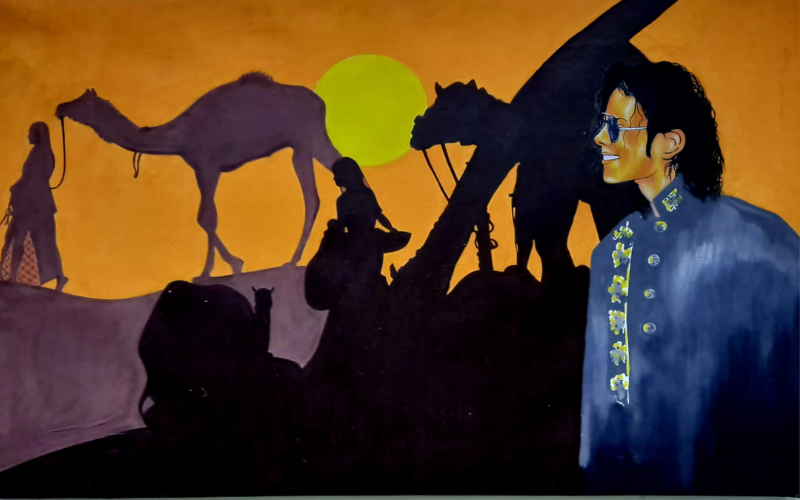
This laid the foundation of the exhibition, with Jackson repeatedly being depicted in portrait and full-body form in the collection. Some works show the performer in iconic poses, while others interpret the mood and themes of his songs through colour and symbolism.
The collection was completed over the course of a year using acrylic and watercolour on canvas, as well as cotton bedsheets on board. He says he works with available and recycled materials.
“The painting titles are inspired by the song titles. Based on that, I try to picture the artist in that setting, and I also use online images of him to create visuals inspired by his music,” he says.

Though only 23 pieces are on display, the 40-work series traces various phases of his life and career. However, Okoth says he was mostly drawn to his 1980s and early 1990s era, when Jackson dominated global pop culture through landmark albums and performances.
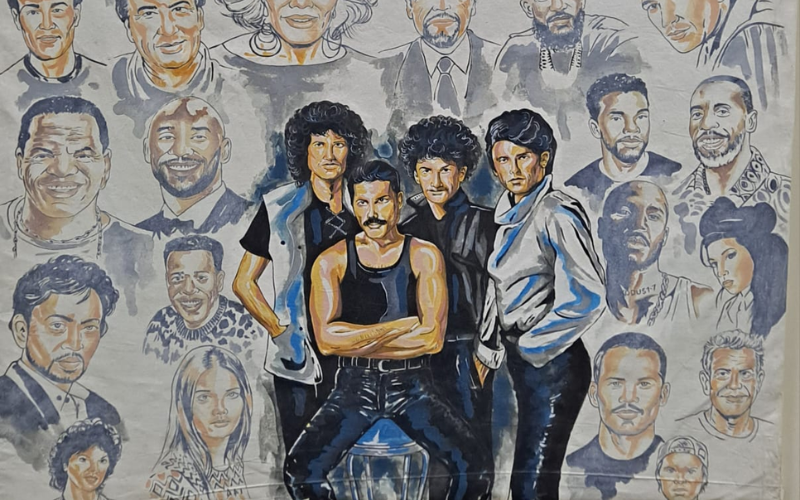
The most demanding work was Gone Too Soon, named after Jackson’s ballad and revolving around the themes of mortality. The piece includes images of public figures who have died and represents how life and fame can fade.
“Life is brief, like a quick dance. You are here today, gone tomorrow,” he says.

Okoth says his relationship with music started years earlier. Since 2011, he has painted musicians and public figures, using sound and celebrity imagery as a repetitive motif. The Michael Jackson series was created between 2016 and 2017 using online reference images and repeated listening sessions.
The greatest challenge facing artists, he says, is finding places to present completed work, a reason why Man in the Mirror only ran for three days.
“The challenge for me as an artist is the platform to showcase the art. The art is available, but there are limited spaces to show it to the general public,” he points out.
He contrasted that with matatu culture, with vehicles serving as moving galleries through murals, typography and bold designs seen by thousands daily.
With Nairobi regarded as an established artistic hub, Okoth says he wanted to see whether similar energy could be cultivated in Kisumu. He describes the reception in Kisumu as encouraging but says the local market still needs stronger support systems and more public engagement with contemporary art.
“Nairobi has a vibrant art culture. We wanted to experiment with Kisumu and to be the pioneers of themed solo exhibitions in the region,” he notes.
He says that many artists in Kisumu are talented but push toward commercially safe curio production. He calls for more galleries, residency studios, consumer education, and dedicated exhibition halls that would allow artists to experiment, fail, grow, and connect with audiences.
He hopes Man in the Mirror grows the audience he built in Nairobi and establishes a stronger following in Kisumu before eventually touring other parts of the country.
“I am hoping to capture an audience in Kisumu too. Eventually, if we can go around the country, we have full potential to be an artistic hub in Africa,” he observes.