



Audio By Vocalize
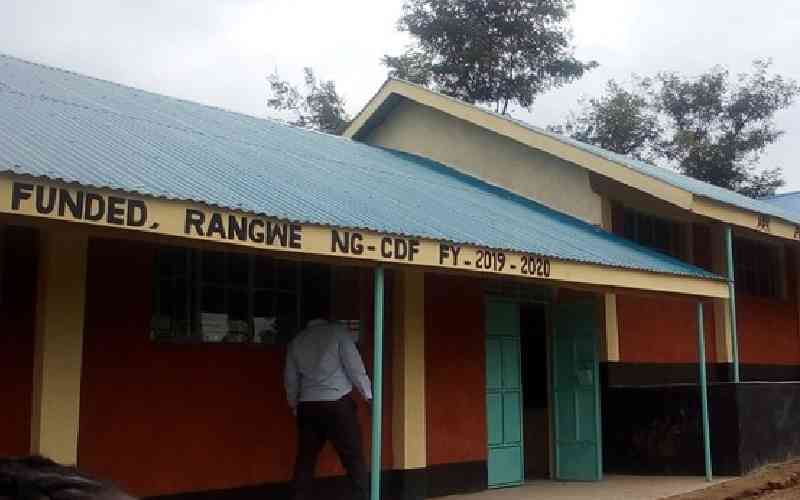
A project funded by the Rangwe NG-CDF. [File, Standard]
Kenya’s development story is often told through grand infrastructure: gleaming highways, railways, and other mega projects.
Yet beneath this narrative lies a quieter, more impactful driver of change: The National Government Constituencies Development Fund (NG-CDF).
For many Kenyans, however, its purpose is misunderstood. Too often, citizens expect roads or healthcare services from a fund never designed to deliver them.
Let’s be clear. NG-CDF does not build roads. That mandate lies with agencies such as KeNHA, KURA and KERRA. It also does not fund healthcare, which is a devolved function under county governments.
The fund’s true purpose, as envisioned by its architects, is more targeted and transformative: to serve as an equalizer for critical grassroots needs, particularly in education, security initiatives such as police posts, and other local development priorities.
When former Ol Kalou MP Muriuki Karue championed the creation of CDF, his vision was rooted in equity. He imagined a Kenya where every constituency, regardless of size or political alignment, would receive a fair share of national resources. This vision became law, with at least 2.5 per cent of the national budget allocated to constituencies.
Nowhere is the impact of NG-CDF more evident than in education. Across the country, it has become a lifeline for thousands of students.
Take the story of Janet Moraa, a student from Njiru Ward in Kasarani. When her father lost his job, her education was at risk. School fees became a huge burden. Through NG-CDF bursaries, she was able to stay in school. Today, she is in medical school, a powerful reminder of what targeted support can achieve. Her story mirrors that of many young people whose futures have been secured through this fund.
Sustained investment in bursaries has delivered tangible results. School retention has improved, transitions to secondary education have increased, and more students are progressing to tertiary institutions.
Families that once faced choices between basic needs and education are now finding relief. This is the equalizing power of NG-CDF in action.
NG-CDF has also played a critical role in building classrooms and expanding facilities to ensure that every child has a place to learn. The priority has been simple but urgent: get learners into school and create space for them to thrive.
However, this is where a hard truth emerges. The current NG-CDF allocation formula does not adequately reflect population differences.
Constituencies with dense populations, receive the same allocation as those with far fewer residents. The result is a strain on resources.
Bursary allocations, for instance, are spread thinner. Students receive smaller amounts, forcing families to bridge larger funding gaps.
On infrastructure, the challenge is even more visible. While some constituencies can move beyond basics to invest in laboratories and libraries, high-density areas are still grappling with fundamental needs like classrooms and desks.
This is not a failure of NG-CDF; it is a call for its evolution. For the fund to remain true to its founding principle of equity, the sharing formula must take population into account. Equity does not mean equal distribution, it means fair distribution based on need.
Despite these challenges, the achievements are undeniable. The fund has proven that when resources are placed closer to the people, they can deliver meaningful, visible change.
NG-CDF works best when it is understood and utilised as intended. The fund is not a catch-all solution for every development need. It is a targeted instrument designed to address specific gaps, particularly in education.
As we look ahead, the conversation must shift from whether NG-CDF should exist to how it can serve Kenyans better. Strengthening transparency, enhancing community participation, and refining the allocation formula are critical steps.
Ultimately, the success of NG-CDF is measured in human stories. It is in the thousands of students whose educational paths have been secured. It is in every classroom built.
These are the quiet victories that define a nation’s progress. They remind us that development is not just about infrastructure, it is about opportunity, dignity, and the promise of a better future for every Kenyan.
Support Independent Journalism
Stand With Bold Journalism.
Stand With The Standard.
Continue
→
Pay via
Secure Payment
Kenya’s most trusted newsroom since 1902
Follow The Standard on
A project funded by the Rangwe NG-CDF.
[File, Standard]
Kenya’s development story is often told through grand infrastructure: gleaming highways, railways, and other mega projects.
Yet beneath this narrative lies a quieter, more impactful driver of change: The National Government Constituencies Development Fund (NG-CDF).
For many Kenyans, however, its purpose is misunderstood. Too often, citizens expect roads or healthcare services from a fund never designed to deliver them.
Let’s be clear. NG-CDF does not build roads. That mandate lies with agencies such as KeNHA, KURA and KERRA. It also does not fund healthcare, which is a devolved function under county governments.
The fund’s true purpose, as envisioned by its architects, is more targeted and transformative: to serve as an equalizer for critical grassroots needs, particularly in education, security initiatives such as police posts, and other local development priorities.
When former Ol Kalou MP Muriuki Karue championed the creation of CDF, his vision was rooted in equity. He imagined a Kenya where every constituency, regardless of size or political alignment, would receive a fair share of national resources. This vision became law, with at least 2.5 per cent of the national budget allocated to constituencies.
Nowhere is the impact of NG-CDF more evident than in education. Across the country, it has become a lifeline for thousands of students.
Take the story of Janet Moraa, a student from Njiru Ward in Kasarani. When her father lost his job, her education was at risk. School fees became a huge burden. Through NG-CDF bursaries, she was able to stay in school. Today, she is in medical school, a powerful reminder of what targeted support can achieve. Her story mirrors that of many young people whose futures have been secured through this fund.
Sustained investment in bursaries has delivered tangible results. School retention has improved, transitions to secondary education have increased, and more students are progressing to tertiary institutions.
Families that once faced choices between basic needs and education are now finding relief. This is the equalizing power of NG-CDF in action.
NG-CDF has also played a critical role in building classrooms and expanding facilities to ensure that every child has a place to learn. The priority has been simple but urgent: get learners into school and create space for them to thrive.
However, this is where a hard truth emerges. The current NG-CDF allocation formula does not adequately reflect population differences.
Constituencies with dense populations, receive the same allocation as those with far fewer residents. The result is a strain on resources.
Bursary allocations, for instance, are spread thinner. Students receive smaller amounts, forcing families to bridge larger funding gaps.
Stay informed. Subscribe to our newsletter
On infrastructure, the challenge is even more visible. While some constituencies can move beyond basics to invest in laboratories and libraries, high-density areas are still grappling with fundamental needs like classrooms and desks.
This is not a failure of NG-CDF; it is a call for its evolution. For the fund to remain true to its founding principle of equity, the sharing formula must take population into account. Equity does not mean equal distribution, it means fair distribution based on need.
Despite these challenges, the achievements are undeniable. The fund has proven that when resources are placed closer to the people, they can deliver meaningful, visible change.
NG-CDF works best when it is understood and utilised as intended. The fund is not a catch-all solution for every development need. It is a targeted instrument designed to address specific gaps, particularly in education.
As we look ahead, the conversation must shift from whether NG-CDF should exist to how it can serve Kenyans better. Strengthening transparency, enhancing community participation, and refining the allocation formula are critical steps.
Ultimately, the success of NG-CDF is measured in human stories. It is in the thousands of students whose educational paths have been secured. It is in every classroom built.
These are the quiet victories that define a nation’s progress. They remind us that development is not just about infrastructure, it is about opportunity, dignity, and the promise of a better future for every Kenyan.
By Ronald Karauri