

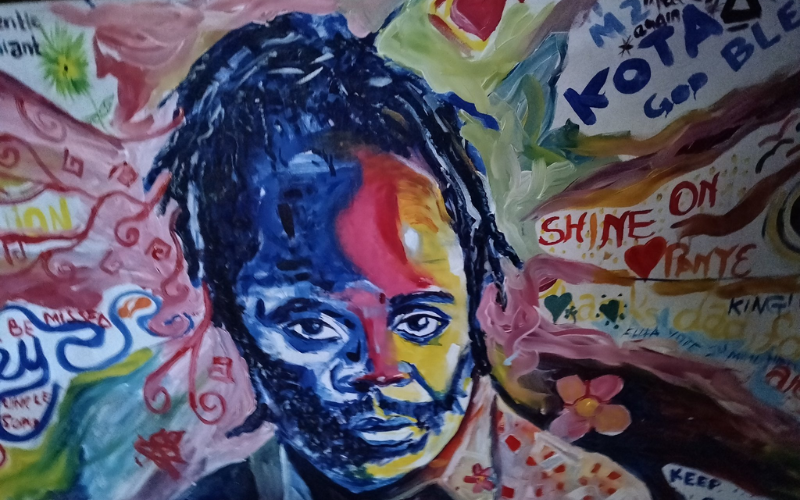
A large puzzle was filled of a gentle giant, Patrick ‘Panye’ Mukabi, at his memorial event on Thursday.
At the Patrick ‘Panye’ Mukabi evening memorial, two sides of the artist came into focus: a man immersed in his practice, barefoot, moving across a packed studio, offering instructions and pausing to study his students’ work as he taught; and a man who, with family, rarely spoke about his art, keeping that part of his life to himself.
Publicly, Mukabi was known as a visionary, accessible, approachable, and generous visual artist who mingled easily with people across ages, but many of his family members knew little about his artistic life until now.
Speaking on behalf of the family at the Nairobi National Museum amphitheatre on Wednesday evening, Mukabi’s brother–in-law Isaac Kamuta said that hearing and processing tributes from artists and other members of the art community felt like piecing together a puzzle.
Hearing about him is like a puzzle being filled that we didn’t know as a family. His soul was in art. He kept it personal and did not want us to find out what he was doing. It was difficult to penetrate that wall for 26 years. I got to know him,” Kamuta said.
Much of what he knew was from the public paintings he would see at the Jomo Kenyatta International Airport and media interviews such as his CNN feature.

Kamuta noted that despite his private artistic life, Mukabi firmly loved his roots. He was not one to miss any family meetings in their ancestral home in Luanda, Vihiga County, to be around his people.
He remembered him for bringing fun and laughter during the meetings, but he never talked about his art.
“He would sit with us, then go back to his art. We are proud to have associated with him. He built a legacy that the nation will appreciate for many years,” he said.
He added that the family were respecting Mukabi’s wishes regarding his burial, and he was cremated on Thursday.
“He leaves behind two children. We would like to find ways to support his legacy,” he said.
Family members, artists, colleagues, and collectors gathered at the amphitheatre for a commemorative event in his honour. Just next to the amphitheatre is a room that once housed the Museum Art Studio, his first place to practise art after leaving school in 1994, at 25 years old. At the time, three other artists – Michael Soi, Peterson Kamwathi, and Simon Muriithi – also worked there.
“He was an extremely generous human being. Since he was older than us and made money before us, he would buy paintings and leave them in the studio for us to use,” Soi said.
Soi remembers spending months with him at a digital art residency in Birmingham, England. After doing an incredible work of shooting videos which Mukabi surprisingly edited, the residency was impressed and gifted them a digital video camera and computer.
When they got to Nairobi, Mukabi sold them and bought canvases and paints.

“We decided to sell them because that is not what we were; we are fine artists. I have no idea how he even got people to buy them,” Soi recalls, with laughter.
He credits him for shaping a whole generation of artists throughout his career.
“He single-handedly produced a new generation of artists. Only Kuona Artists’ Collective has done that, but Mukabi did it in his own way, individually. It is no small feat,” he said.
Peterson Kamwathi said Mukabi’s was the first workshop he attended and taught him how to become a professional artist at the Museum Art Studio. He praises him for having time for young artists and mentoring them generously.
Mukabi was warmheartedly remembered as a mentor who shaped generations of Kenyan artists through spaces such as Kuona Artists’ Collective, Museum Art Studio, GoDown Arts Centre, and Dust Depo Artist Studio at the Railway Museum.
In his studios, especially at the Dust Depo, Mukabi built what many described as a creative refuge for young artists who mostly came from unprivileged backgrounds. His protégés, going by the names Mukabilets and Panyelets, are a long list including Nadia Wamunyu, Jimmy Kitheka, Mbogo Weru, Swift Graffiti, Bankslave, Alex Mbevo, and Dickson Kaloki.

In venues such as the Creativity Gallery at the Nairobi National Museum, many of the protégés exhibit their works. One such artist is Nyerere Michael, who met Mukabi in 2016 at Dust Depo, a space he termed a sanctuary. Once a coffee seller, Nyerere would go to the studio in the evenings. He stopped selling coffee, and he would religiously go to the studio to learn and practise art.
As one of the few artists who were entrusted with the studio key, Nyerere would arrive at 5.30am and would find Mukabi there, barefoot and working and teaching. Barefoot, for he would say that he could not think with his shoes on.
“He shouted our names. He knew everyone’s names. He was a man for all. He made sure everyone had eaten even when he had not,” Nyerere said.
They had an eventful evening on Nyerere’s 23rd birthday that began with the artists, including Mukabi, teaching art to young cancer patients at the Kenya National Hospital. After a disagreement with an officer, Mukabi was arrested. Nyerere and the artists spent the night at a police cell with Mukabi, who, after seeing them, asked them what they were doing there.
“We told him that we wouldn’t have left him. That was a birthday to remember. He was the first one to buy me a birthday cake. He showed me that he can really be there for me in every way,” he said.
When Nyerere held his solo exhibition titled Freefall at the Creativity Gallery in November 2025, he was surprised to see Mukabi limping his way to him. He had not told him about it but was surprised to see him there even when he was ailing. During the exhibition, he shared the stage with his mentor.
When he was admitted to hospital, Nyerere gave him a sketchbook before he headed to his residency in South Africa.
“I told him to fill the sketchbook in the same way he gave us assignments. I thought I would see it filled when I came back, but that was our last conversation. I wish I were there for him during that time,” Nyerere said, fighting back tears.
He continued: “He made me into the man that I am today. He taught me to speak in front of people like I am doing now and to be bold in speaking the truth.”
Visual artist and Mukabi’s mentee Eric ‘Stickky’ Muriithi met Mukabi in 2009 at his studio in GoDown Arts Centre. He showed him sketches and gave me studio access. After his media studies in 2013, Stickky joined him at the Dust Depo, and he was entrusted with a studio key. Through Patrick, he met Nyerere, who became his friend.
He reminded artists to keep his long-standing philosophy of using lots of paints, generously so, “like butter on bread”.
Artists who trained under Mukabi described him as both a teacher and a father figure. “To open his doors was his way of showing the joy of art, of being a human being. We will forever miss him and will be sad for the longest time,” Stickky said.
Njeri, one of Patrick’s friends, narrated that she met him in 2006 when he was based at the Kuona Artists’ Collective, formerly Kuona Trust. She asked him if he got distracted with voluptuous women as his favourite muses.
“I am too absorbed in the moment to get distracted,” he replied to her.
His lasting legacy, she says, is all the children and young artists that he taught. He mentored children as young as three years old who affectionately called him “Uncle Supuu”, while older mentees knew him as Panye.
Videos played during the memorial showed him mentoring emerging talents, offering advice on exhibitions, branding, and professional practice. In one video, visual artist David Maina, one of his mentees, said Mukabi was a central figure in his development.

“He gave us advice on how to prepare for exhibitions, brand our work, and market ourselves. I will stay here until I feel ready to branch out on my own,” he said.
Mukabi himself, in recorded remarks, reflected on his teaching philosophy.
“When I am teaching a workshop, I am also learning,” he said, joking with participants. “Your work cannot be better than mine—I am the master.”
He also spoke about balancing creativity with structure. Many artists, he observed, don’t want to conform to the business world, but there are deadlines, contracts, and so on.
Silvia Gichia, former director of Kuona Artists’ Collective, described Mukabi as a cultural force with a lasting impact in Nairobi’s art ecosystem.
“He is a cultural enigma whose impact touched Kuona and private homes alike. To own a Mukabi is to have a piece of the country,” Gichia said.
GoDown Arts Centre executive director Joy Mboya said Mukabi’s work created opportunities for young artists that institutions had failed to provide.
“Dust Depo was the beginning of institutionalising arts training. We have to continue what he started,” she said.
As tributes continued, questions emerged about the future of the spaces he created. A family member raised a concern that lingered over the evening:

“Patrick died without having any studio. Is it fair that he died without a studio? Where will the young artists go?” he posed.
Artists and institutions present said discussions were ongoing on how to preserve and continue Mukabi’s legacy through existing and emerging art spaces.
The memorial featured a candle-lighting ceremony, live music, tributes, a screening, and live-streamed reflections from collaborators and friends.
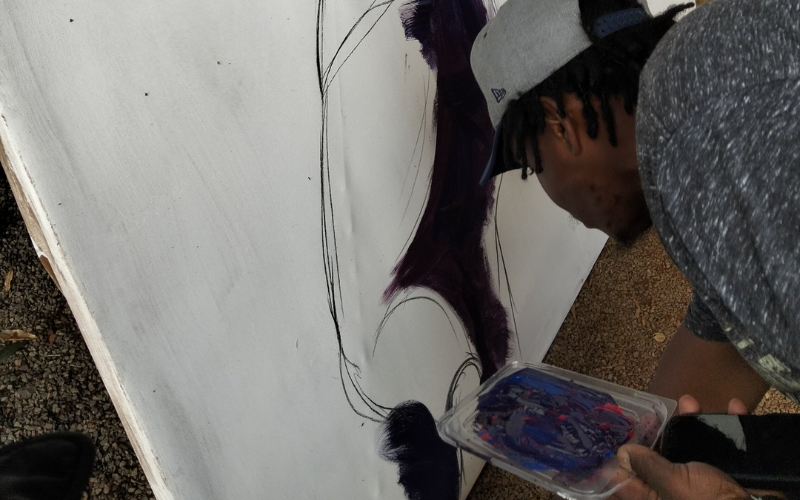
The event followed a bonfire gathering on Tuesday evening at Kuona Artists’ Collective, where artists shared memories and tributes and took part in a mural painting session celebrating Mukabi, who passed away on March 23, 2026.
Mukabi’s artistic journey began in graphic design, encouraged by his father for employment reasons, but he left after a few months to pursue fine art. Over the years, his work evolved from oil painting to acrylics, charcoal, collage, and metalwork, with exhibitions in 23 countries.
His last public participations were an exhibition titled Dust to Form with his protégé Jimmy Kitheka at Ardhi Gallery in May 2025 and an art exhibition and contest by the Iran Cultural Centre in Nairobi in December 2025.