



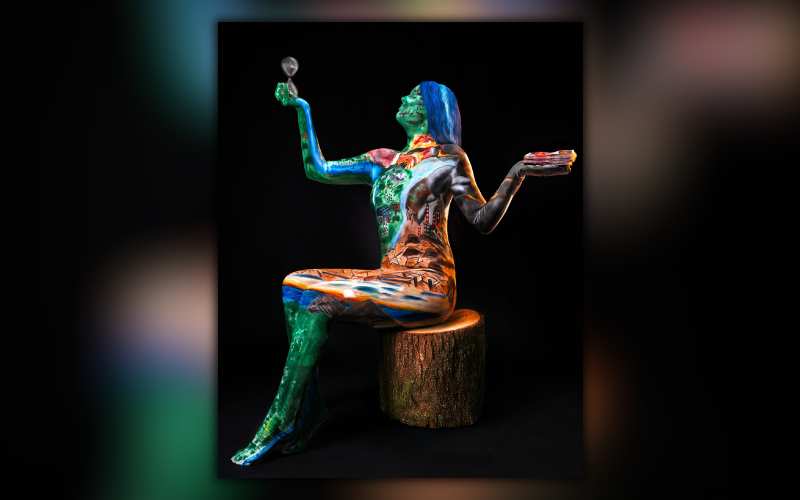
In one of her most striking works, a human body becomes a living timeline.
From the toes, a lush green landscape emerges under a rising sun. By the chest, that harmony fractures into scenes of environmental strain, only to soften back into restoration at the head. The figure holds an hourglass, a quiet but urgent reminder that time is running out.
This is Tik’ Tok’ (Living Canvas for Climate Change), a 2025 commission that captures the essence of Paskaline Maiyo’s art.
For her, the body is a narrative structure, beyond the surface.
Based in Cardiff and born in Kenya, the interdisciplinary artist works across body art, portraiture, performance, and film. Her central idea is simple: the human body can be both the medium and the message.

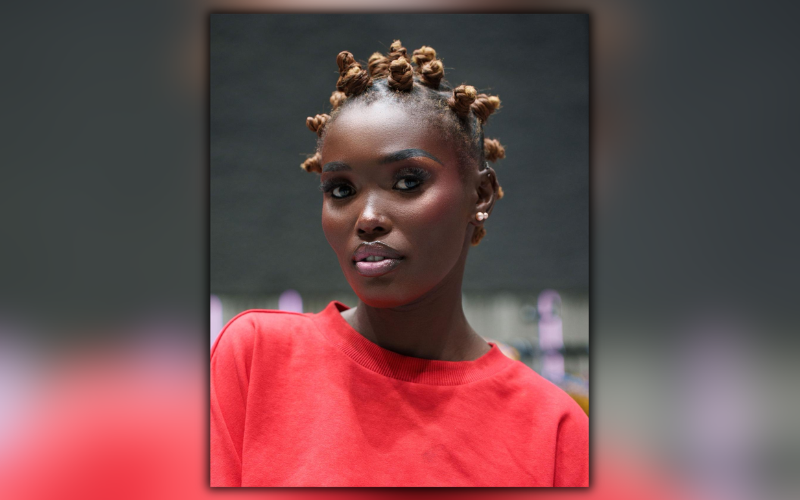
“Art does not belong to the canvas; it flows through the creator and exists in any form the mind can imagine,” Maiyo says. This philosophy drives her rejection of static, traditional formats. In her hands, art interrogates identity, migration, climate justice, and mental health.
In her piece A Body of E-art-h’ (2025), the human form becomes an ecological map. Water flows from head to torso, wildlife inhabits the limbs, and vital organs are overlaid with environmental symbols.
Here, lungs represent air quality, while marine life swims near the abdomen. The work frames the human form as inseparable from nature, making environmental damage feel personal and physical.
There is a deliberate clarity to this symbolism.

Maiyo often favours directness over ambiguity, ensuring her message is accessible to everyone. This approach is strikingly clear in how her work is shared.
Beyond traditional galleries, her installations appear in outdoor spaces across Greater Manchester and Wales, as well as on billboards and in civic squares. She insists on placing art within the flow of everyday life rather than behind the closed doors of elite institutions.
Born in Iten, Kenya, one of the country’s most popular areas and home to many high-octane world champion athletes, Maiyo’s journey began in 2018 during a university strike in Nairobi.
Facing uncertainty, she taught herself to draw, eventually creating a presidential portrait series that gained national attention in Kenya.
But a move to the United Kingdom in 2022 marked a pivotal shift, transitioning her from a Land Administrator to a professional visual artist.

Since then, she has exhibited at the Africa Foto Fair 2025 and received the Marsh Award for Excellence in Visual Arts Engagement.
At the core of her practice is the experience of the diaspora, a journey she describes as both grounding and transformative.
“Being away from home and navigating new cultural and professional spaces has humbled me, teaching me how to adapt while still holding my roots close,” she says. “Through my art, I continuously revisit my upbringing, using it as fuel to live and grow in a new environment without ever losing where I come from”.
This tension between movement and memory gives her work its emotional anchor.

While her themes are global, they are filtered through a distinctly African lens that insists on visibility in international spaces.
Alongside her studio work, Maiyo is also a festival producer and the founder of The Catwalk Club, a modelling academy in London and Cardiff.
Her commitment to public visibility led to her being named one of Cardiff’s “Unsung Heroes” for the Bradford UK City of Culture 2025. This recognition was followed by a collaborative project with acclaimed photographer Aïda Muluneh, further cementing her status as a rising voice in the diaspora.
Her self-photographed piece, ‘Depletion’ (2024), remains a powerful example of her personal style, using her own body to mirror the planet’s fragility. She explains that the work reflects how environmental decay presses on the human psyche, with a single leaf breaking through a damaged surface to symbolise nature’s persistence. Through her art, Maiyo aims to continue challenging stigma and amplify underrepresented voices.