

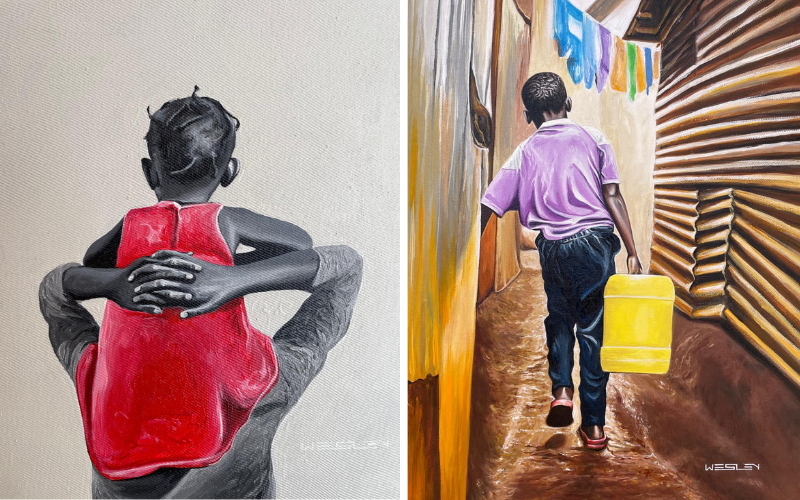
Wesley Osoro, an artist from Kibera, creates evocative paintings of faceless figures that centre on hope, resilience, everyday life, and a strong sense of community.
His work captures a vibrant and diverse life in his community, thus challenging predominant narratives of poverty and hardship associated with the area.
Raised in Kibera, Osoro embarked on his artistic journey to document and communicate the aspects of his surroundings that don’t get their way outside of its physical boundaries.
His faceless portraits have since been a signature style and a metaphor for the marginalised voices and the anonymity faced by many in slum environments.

It speaks of the individuality and stories of his subjects despite their faceless depiction.
“Faceless stories allow me to hide the identity of my characters while telling different positive stories about my community. Great things come from places that are least expected,” he says.
Growing up in Kibera, he recalls, was not easy, but it made him stronger and resilient as he found his artistic abilities.
I would make art for fun until people changed their perception when they interacted with his artworks more than he did.

They appreciated it by buying, which motivated him more, and it made him appreciate his work more.
His ongoing project, titled Kibera Stories is a humanised portrayal of life in the settlement.
Through it, he captures social, economic, cultural, and political narratives from an insider’s perspective.
They focus on children and women, whom he says are the most affected in the community.
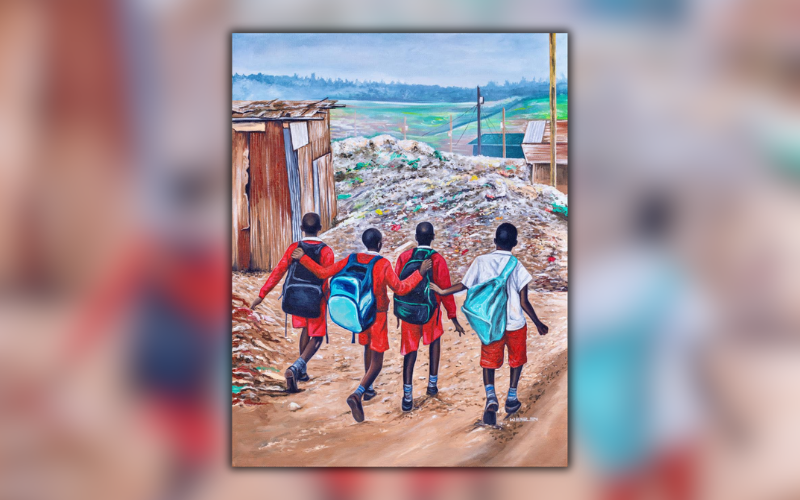
“In Kibera, people focus on the negative side, like poverty, poor drainage, and crime. My work tries to tell positive stories about fashion, talent like art and football, and smart, hard-working people,” he says.
Osoro expresses hope through the bright colours that he uses in his painting and explores themes such as education, access to water, and other social concerns.

He has exhibited his work at Uweza art events and has shown internationally in the United States and the United Kingdom.
Despite this growing recognition, he is grounded in his community, whose response to his work continues to inspire him.
“People in Kibera really appreciate my work. That, to me, is very inspiring,” he says.