

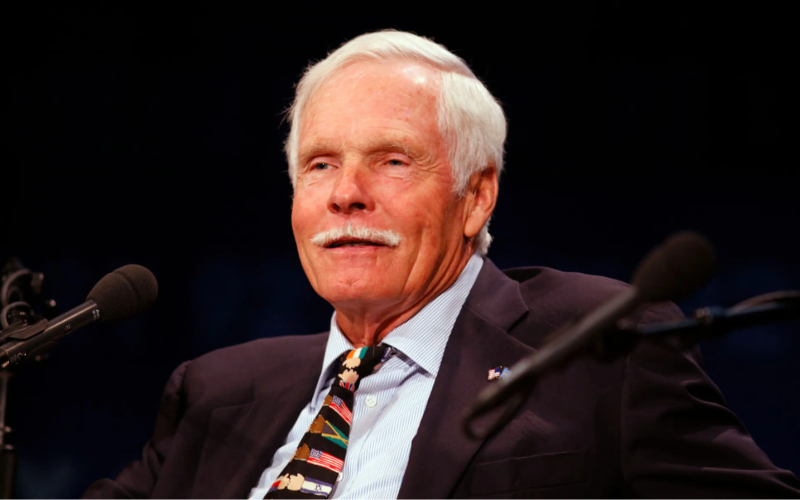
Ted Turner, the visionary media mogul who revolutionised the global information landscape by founding CNN, has died at the age of 87.
His passing marks the end of an era for the industry he reinvented through the creation of the world’s first 24-hour news network.
CNN chairman and chief executive Mark Thompson confirmed the news in a tribute to the man who built the organization from a scrappy Atlanta start-up into a global powerhouse.
“Ted Turner was a pioneer, a visionary and a giant on whose shoulders we all stand,” Thompson said. “He was intrepid, fearless and always willing to back a hunch and trust his own judgment. He was and always will be the presiding spirit of CNN.”
While no official cause of death was immediately released, Turner revealed in 2018 that he was battling Lewy body dementia. The progressive neurological disease had largely kept the man once known as the “Mouth of the South” away from the public eye in his final years.
Before Turner launched CNN in 1980, television news was a rigid affair restricted to evening time slots.
Critics famously mocked his 24-hour concept as the “Chicken Noodle Network,” predicting it would fail within months.
Turner proved them wrong by providing live, unfiltered access to history, most notably during the 1986 Challenger disaster and the 1991 Gulf War.
His influence extended far beyond the newsroom. As the head of Turner Broadcasting System, he turned TBS into a national “superstation” and built a massive sports empire.
He owned the Atlanta Braves and the Atlanta Hawks, and he was an elite sportsman in his own right, famously winning the America’s Cup in 1977.
Turner was equally famous for his eccentricities and his high-profile personal life, including a ten-year marriage to actress Jane Fonda.
CNN founding anchor Mary Alice Williams recalled him as a “go-for-broke idea guy” who believed that global communication could eventually lead to world peace.
In his later years, Turner became one of the world’s most significant philanthropists.
He made international headlines in 1997 by pledging $1 billion to United Nations causes.
Even his rivals acknowledged his impact, with Donald Trump describing him this week as “one of the greats of broadcast history.” Turner leaves behind a legacy that ensures the world remains connected in real-time, forever changing how we witness history.