

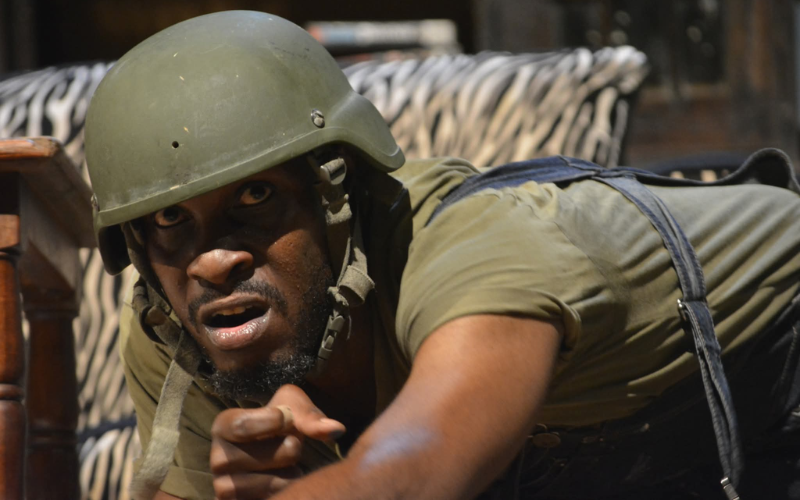
When the auditorium emptied after the staging of Adipo Sidang’s play In the Seashell Hum, conversations continued about this psychodrama play.
It dives into mental health issues, especially PTSD and alcoholism, with water and sounds as elements explored throughout the play.
The story follows Baraka (Nick Ndeda), a former Navy officer haunted by the death of his cousin Athuman (Gitura-Kamau).
Years later, Baraka lives in Malindi, where he battles PTSD, and his condition is tied to sound, especially sounds connected to water. The sea’s crashing waves, whispers, rustling trees, and dripping tides constantly invade his mind and affect his memory, reality, and hallucinations.
Baraka holds onto a radio he used during his Navy service. He is constantly alert and believes people are after him, thus creating chaotic psychological and physical experiences for him and those around him.

Baraka continues to see and speak to his dead cousin, Athuman, and they talk about their lives while they were in the navy with Athuman’s father.
Baraka is the only one who can see Athuman, who is a source of disturbance and comfort, at times worsening his symptoms and at other times offering a voice of reason.
Early in the story, we are introduced to Baraka’s relationship with his girlfriend, Salma (Foi Wambui). Baraka’s condition also affects those closest to him, especially Salma and his sister Kendi (Angela Mwandanda), who try everything they can to convince him to seek medical help, but he refuses.
His alcoholism and destructive behaviour are strongly depicted in the play, and he sees Athuman as if he were alive, telling Salma that Athuman is part of a wedding committee and that a wedding is approaching. Salma is excited to attend the wedding, only to discover later on that Athuman died ten years ago.

He is stubborn and resists going to see a doctor. He denies the severity of his condition and also struggles with alcoholism, which he refuses to admit. It stems from his Navy years, where drinking was part of a culture of endurance, long deployments, emotional suppression, and constant alertness.
He is also a gifted visual artist, but his mental health symptoms make him question his work and distort his confidence in what he creates, even as his art is a reflection of his inner world. In one of his pieces is a portrait of his dead mother, who died by drowning herself.
Baraka also struggles with PTSD; he believes that there is a lady who is wearing black in the neighbourhood who is spying on him, and we get to later see that black is triggering for him because of his childhood with a man who wore black and who used to wear navy attire. So the colour disturbs him, and he views people who wear black as spies, and anyone who he feels is against him, he labels as a spy or says that they are after him.

The audience was moved when, at one point, he hit his head with a framed portrait and broke it.
The play depicts how soldiers are affected by PTSD. Excerpts of the play were staged in different artistic spaces in April to spread awareness on alcoholism during Alcohol Awareness Month and to explain how substance use worsens mental health conditions. It also highlights how alcoholism intensifies mental health struggles.
During the premiere night on May 15, Esther Passaris, speaking on behalf of Hon. Canon Ida Odinga, highlighted that many men and young people face silent struggles around mental wellness.
“Too many young people are sinking into loneliness, depression, and addictions. We continue to lose brilliant minds, talented artists, and promising young lives. Many fathers, too, are hurting deeply, and some feel stripped of dignity and purpose because of financial pressure and the burden of providing for families,” she said.

Many young men, she added, are battling stress, drug abuse, gambling, alcohol dependency, and emotional isolation. Passaris urged society to break the silence, become more empathetic, more present, and more willing to listen without judgment.
The producer of the play, Mudamba Mudamba, said that they intended to make mental health a subject of discussion and to create interest to move it from awareness into action.
“I believe we have set great momentum. We did not get our money back, as Adipo did spend a lot, but I believe money can follow the project, and a film can be made. People have continued conversing, which is most important as it is an urgent issue,” Mudamba said.
This psychological, intellectual play is one that has sparked conversations around mental wellness. And it is one that you are sure to watch again and see the depth of Baraka’s struggles.
Photos: Courtesy