


Audio By Vocalize
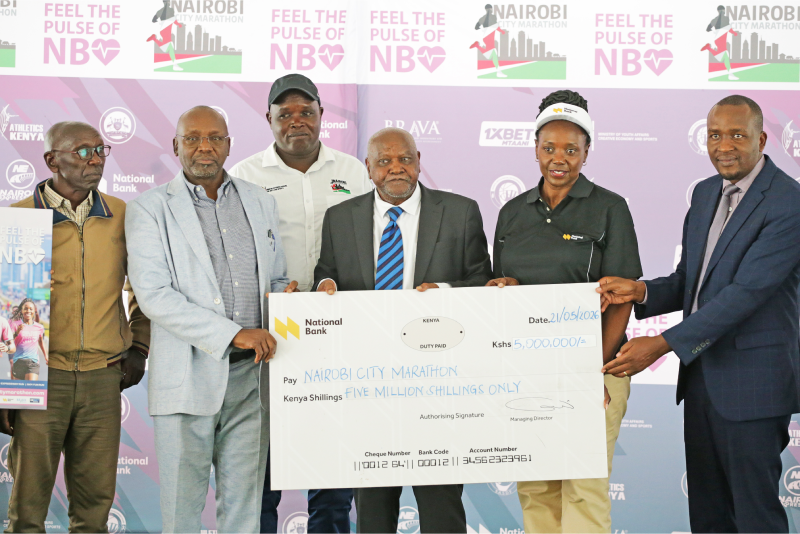
Kenyan trio of Jonathan Korir, John Langat, and Simon Kipkosgei are among the top athletes who will storm the capital city’s streets for the fifth edition of the Nairobi City Marathon.
The already sold-out competition slated for June 7 has attracted a staggering 17,000 runners from 75 countries, including the United States of America, Britain, China, Ethiopia, Japan and Russia, among others.
Just like the past editions, the athletes will compete in four different categories, namely, 42km full marathon, 21km half marathon, 10km run, and 5km fun run. Benson Tunyo Murkomen and Emily Chepkemoi clinched last year’s marathon with times of 2:08:36 and 2:25:45, respectively.
Felix Masai, who has run 60:08, will battle for glory in the 21km men’s race alongside Francis Ewoi, who has a personal best of 60:52. While the female field will be led by Sharon Cherotich with a personal best of 68.
This year, the race will start at City Hall and end at Uhuru Park, with winners of the men’s and women’s marathon pocketing Sh3.5m each in prize money. The 42km full marathon will kick off at 6.45 am, followed by the half marathon at 9 am, before the 10km run at 10 am, and then the 5km fun run at 11 am.
While lauding the growth of the competition, which has put the country on the global map since its first edition in 2022, Race Director Barnaba Korir said they are truly living their dream as they incorporate the elite field in the event. “Five years ago, we dared to dream of a marathon that would put Nairobi on the global running stage. Today, that dream is a living, breathing reality. The Nairobi City Marathon has become more than just a race. It has become a trademark of this city,” said Korir during yesterday’s media launch.
“It is an event that Nairobi owns with pride. If you see the interest that has been garnered through this event, it is unbelievable that we started five years ago, and now we are approaching being one of the best marathons in the world. And this year, our theme captures it perfectly, ‘Feel the pulse of Nairobi’, because that is exactly what this marathon is all about. It is the heartbeat of our city.
He continued, “We know we started this marathon just as a dream. When we started the first edition, we had only 10,000 runners, which was already a remarkable achievement. Then we grew to 13,000 and then to 15,000. Each year, the positive feedback was overwhelming. And the interest from both local and international runners kept growing beyond our expectations.
“This year, we have surpassed every record we have already set. We now have 17,000 already registered runners, and we have closed it. We are now trying to see how we can actually organise the best-ever marathon in Kenya. It is not just a number, it is a statement.”
And based on the successes of the race, which got a sponsorship of Sh5 million from National Bank of Kenya yesterday, Korir, who doubles up as Athletics Kenya’s Youth Development Director and National Olympic Committee Kenya’s (NOC-K) First Vice President, wants the country to host a major marathon.
“These are not just fast runners. These are some of the finest marathoners on the planet, and they are coming here to Nairobi to feel the pulse of the city. And our athletes have shown that, yes, they have the capability, the strength, the energy and the focus to achieve the impossible,” said Korir.
“If you recall, five years ago, in this marathon, we didn’t have very many people on the road. But the good nurturing of talent and youth development has seen many people join it,” Ngara said.
With the race having already embraced science and technology, Stockholm Environment Institute’s (SEI) Research Fellow Ngongang Wandji, who represented Niall O’Connor, Director of SEI Africa, at the event yesterday, said they are looking forward to an exciting showpiece.
“Over the last few years, Nairobi has become a unique platform for demonstrating how environmental science can support safer and healthier sporting events. This year, eight air quality sensors will again be strategically deployed along the marathon route to generate real-time data on particulate matter and environmental conditions,” said Wandji.
“This is scientifically important because marathon athletes experience significantly elevated breathing rates during competition, increasing exposure to pollutants. Monitoring air quality along the route, therefore, becomes an important component of athlete safeguarding, public health protection, and sustainable event management.”