

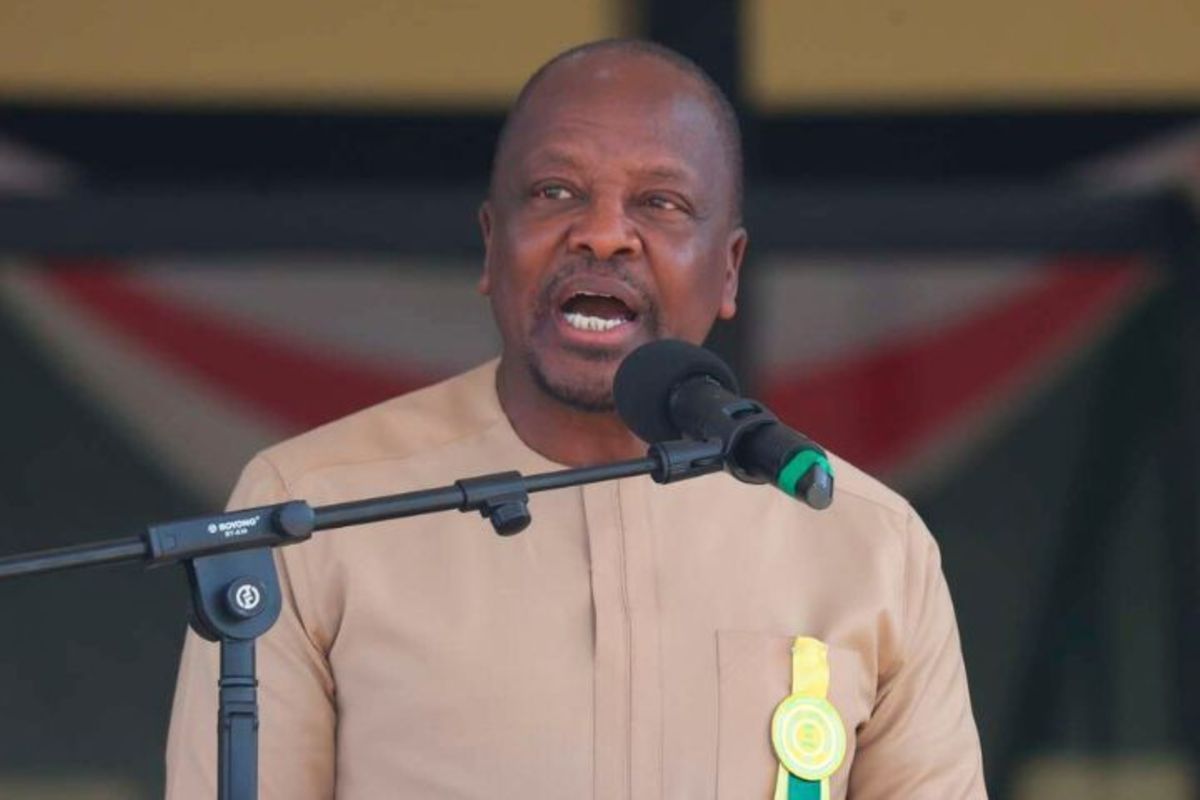
Farmers must turn to digital tools, climate-smart practices and scientific soil management to withstand increasingly erratic weather, rising production costs and declining soil fertility, Agriculture and Livestock Development Cabinet Secretary Mutahi Kagwe has said.
Mr Kagwe said technology should help farmers decide what and where to plant, which inputs to use, when to plant and where to sell as climate change disrupts production.
“The future of Kenya’s agriculture will not be determined by the government alone. It will be determined by the strength of the partnerships we build between farmers and government, research and industry, innovators and investors, and national and county governments,” Mr Kagwe said on Thursday while opening the 125th Nairobi International Trade Fair at Jamhuri Park in Nairobi.

Cabinet Secretary for Agriculture and Livestock Development Mutahi Kagwe tries his hands on a mini tractor at the Nairobi International Trade Fair at Jamhuri Park Showground on September 30, 2026.
The seven-day fair, organised by the Agricultural Society of Kenya (ASK), runs from September 28 to October 4 under the theme “Promoting Climate-Smart Agriculture and Trade Initiatives for Sustainable Economic Growth.”
It brings together farmers, livestock keepers, agribusinesses, researchers and technology firms to showcase artificial intelligence-powered solutions, drones, irrigation equipment, machinery, improved livestock breeds, animal-health technologies, climate-resilient crop varieties and value-addition equipment.
ASK Chief Executive Officer Batram Muthoka said the fair was responding to the changing needs of farmers, with climate change making technologies that improve efficiency and resilience increasingly important.
“We are picking initiatives that help the farmer and the entrepreneur to mitigate the challenges that come with climate change,” Mr Muthoka said.
Mr Muthoka said the fair had evolved into a platform where farmers could interact with technologies, innovations and businesses that improve their enterprises.
Mr Kagwe said droughts and floods linked to climate variability were estimated to create economic liabilities equivalent to 2.8 per cent of Kenya’s Gross Domestic Product annually, with agriculture bearing the cost through crop failures, livestock losses and disrupted markets.
Read: Meet entrepreneur transforming fish farming through technology
“Our objective is not merely to respond to climate shocks, but to enable farmers to anticipate, absorb, adapt to and recover from climate shocks,” Mr Kagwe said.
The government is strengthening digital infrastructure for farmer identification, extension, inputs, insurance and finance.
Mr Kagwe cited the Kenya Agricultural and Digital Information Centre (KADEC), participating in the show for the first time, as an initiative to create a central source of agricultural data and technology.
He said about 8.9 million farmers had been registered under the Kenya Integrated Agricultural Management Information System and the Animal Identification and Traceability System (ANITRAC), making it easier to target services such as vaccination and extension.
Soil health was another focus, with Mr Kagwe saying 63 per cent of Kenya’s soils were acidic. He urged farmers to test their soils before applying fertiliser to avoid wasting money and nutrients.
The government has launched the National Digital Soil Works Project, bringing together laboratories under the Kenya Agricultural and Livestock Research Organisation (KALRO) to support soil testing and management.
Mr Kagwe said automated soil testing, aerial surveying, geospatial mapping, digital identity, e-extension and last-mile agricultural entrepreneurs could improve access to information and services.

Cabinet Secretary for Agriculture and Livestock Development Mutahi Kagwe admires a winning goat from Siget Farm Kisumu during the Nairobi International Trade Fair at Jamhuri Park Showground on September 30, 2026.
The fair is showcasing livestock technologies as farmers seek to maintain production during drought and feed shortages.
Mr Kagwe said the government was investing in animal health, improved breeding, dairy productivity and market access while strengthening meat value chains.
“Recent milk supply constraints associated with dry conditions reinforce the need to strengthen year-round access to affordable livestock feeds and expand livestock insurance programmes,” the CS said.
Crop and livestock exhibitors are displaying improved breeds, feeds, breeding technologies, animal-health products, irrigation systems, machinery and climate-resilient varieties.
The fair is also focusing on value addition and markets. Mr Kagwe said higher production must be matched by reduced post-harvest losses, expanded agro-processing and better market access.
“We must ensure that what we produce is preserved, marketed and converted into value,” he said.
Mr Kagwe urged exhibitors, farmers, investors and other stakeholders to use the fair to form partnerships and scale technologies that can improve agricultural productivity and incomes.
Follow our WhatsApp channel for breaking news updates and more stories like this.