

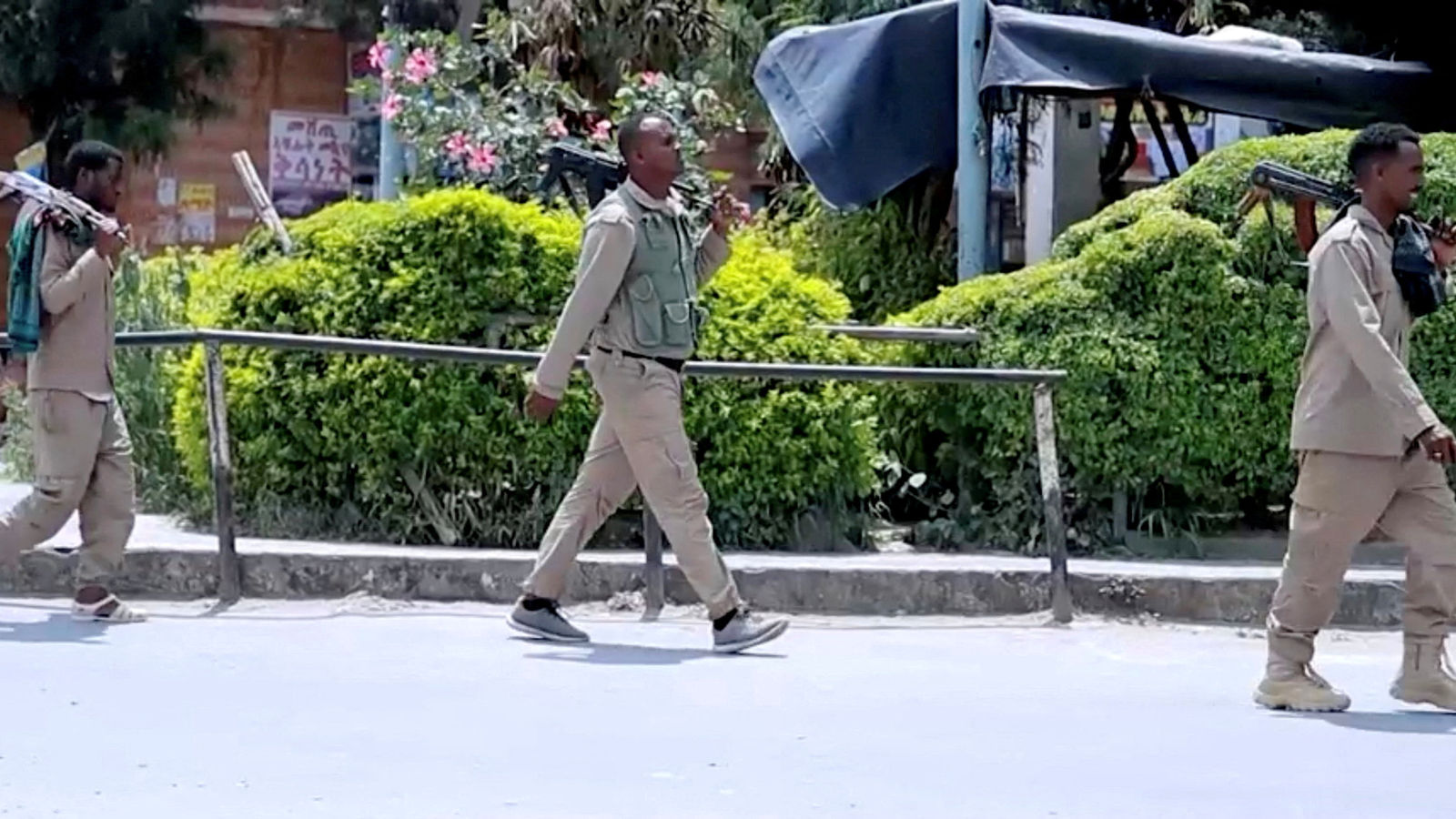

After months of tension, fighting has erupted in northern Ethiopia between federal troops and a rebel alliance headed by Tigrayan forces.
On the surface, the clashes look like the revival of the 2020-2022 civil war that pitted the Tigray People’s Liberation Front (TPLF) against the federal government and killed hundreds of thousands of people.
This time, however, the Horn of Africa region with Ethiopia at its heart is much more unstable.
Tangled alliances and rivalries
The opposing sides in the fighting have ties to countries embroiled in a string of other interconnected conflicts, rivalries and alliances, all driven by past enmities and competition over influence and territory.
That tangled web stretches from Chad in north-central Africa to the heart of the Middle East. Each intervention across one border risks adjusting calculations across others. Experts fear war could spread far beyond Ethiopia’s frontiers.
Unlike in the 2020-2022 war, Ethiopia and neighbouring Eritrea now find themselves on opposing sides.
Conflict in their shared neighbour, Sudan, has drawn in both countries, alongside other states in Africa and the Gulf.
Down the coast, Somalia’s security crises are deepening, threatening to fragment the country further as foreign powers eye its self-governing regions for their coastline.
Against this background, the Iran war and the involvement of Yemen’s Houthis just across the Red Sea from Eritrea have increased concerns over trade routes through that waterway.
Underpinning much of the tension is the feud between Saudi Arabia and the United Arab Emirates, which escalated in Yemen last year but has spilled over into the Horn of Africa.
How important is the fallout between Eritrea and Ethiopia?
In the last war, Eritrean forces supported Ethiopian Prime Minister Abiy Ahmed’s government. This time round, Ethiopia accuses Eritrea of backing the rebel alliance, an accusation Eritrea denies. Eritrea severed diplomatic ties with Ethiopia after Addis Ababa ordered the closure of its embassy in Asmara.
Diplomats and analysts say Eritrean President Isaias Afwerki is, for now, providing rebels with access to the coast and the rest of the world through his country. During the last war, Tigrayan forces were cut off on all sides.
At the heart of the shifting alliances are decades of conflict and distrust. Ethiopia and Eritrea fought each other between 1998 and 2000. One core point of contention is Ethiopia’s long-standing quest to restore direct access to the sea, lost when Eritrea gained independence in 1993.
The head of Ethiopia’s military has accused Sudan and Egypt of supporting Eritrean operations in Ethiopia. Both countries have denied any meddling.
Both are also at odds with Ethiopia over its development of a giant hydroelectric dam that they say could threaten their access to water.
Why is the Ethiopia fighting linked to the war in Sudan?
Sudan has been divided by a three-year power struggle between its military and the paramilitary Rapid Support Forces (RSF) that has created one of the world’s worst humanitarian crises.
Both sides rely heavily on support from external backers, who are pressing for regional influence and pushing their own causes.
The UAE, a major backer of the Ethiopian government, has supported the RSF, according to United Nations experts. The UAE denies the accusations.
Ethiopia has also been accused of backing the RSF, including hosting a secret training camp in the west of the country. Addis Ababa denies it supports the RSF.
For its part, Sudan’s military has had backing from a range of actors, including Egypt and Eritrea, while maintaining close ties with Saudi Arabia.
Underscoring how such ties can stoke conflict across borders, several diplomats told Reuters some Tigrayan forces have fought alongside Sudan’s army, and that Khartoum hosted meetings that led to the creation of the Ethiopian rebel alliance.
Why does the UAE-Saudi rivalry matter in Africa?
In recent years, the UAE has become an influential player, forging relationships in the Horn of Africa through multi-billion-dollar investments, robust diplomacy and discreet military support.
The UAE has struck deals with Somalia’s breakaway region of Somaliland and semi-autonomous Puntland – both of which could help give its landlocked ally Ethiopia access to the Red Sea.
Israel, also an ally of Ethiopia, is the only country to have recognised Somaliland as independent and is training local forces there.
Saudi officials say Emirati activities in Yemen and the Horn threaten their national security and Riyadh has been building its own alliance south of the Red Sea. An Emirati official said the Gulf and the Horn of Africa regions depended on each other and the UAE was providing essential investment and security that African leaders were calling for.
While relationships are not hard and fast, Saudi Arabia is broadly aligned with Sudan’s military, Egypt and Eritrea – all of whom are rivals of Ethiopia.
Follow our WhatsApp channel for breaking news updates and more stories like this.