

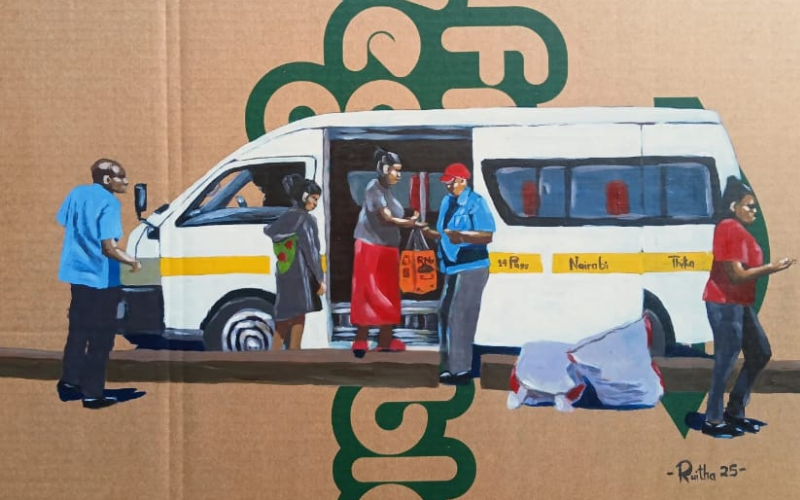
In Ruitha Maina’s view, Nairobi is a city full of stories. Its people, transport system, language and everyday interactions are a source of inspiration for his work.
His latest exhibition, When You Come to Nairobi, brings together three bodies of work exploring the city and its socio-economic fabric. The exhibition opened on September 11 and runs until October 12 at Wasp and Sprout in Loresho Ridge, Nairobi.
The exhibition is showing Hustlers of Nairobi, the Yellow Line and Negative Space, three bodies of work that Maina has created over several years.
Maina says that the exhibition is informed by his observations of his surroundings and the socio-economic experiences of the country. He is interested in people whose work drives the economy but who are overlooked.
“I wanted to tell the stories of people who are often overlooked or not recognised by society. The people who are at the bottom of the economy are the ones who are feeling it the most,” he says.
Hustlers of Nairobi is a series that explores casual and blue-collar workers in the city. He says that he wanted to draw attention to people whose struggles are less visible.
The series started in 2024 and examines labour and how people work together in a community. He was interested in people who work not only for financial gain but also because of their love for their jobs and the people they care for.
The life-size works combine acrylic paint, newspaper prints, image transfers and charcoal. The different materials allow him to layer several ideas and explore the socio-economic and political state of the country.
The people he depicts are those he considers overlooked, the unseen workers of Nairobi.
“The blue-collar workers are the humblest people you can meet, and when you talk to them and you hear their stories, it is about love. They do the jobs for love,” he says.

The exhibition also includes the Yellow Line, a series that began in 2023 and explores humour, conversations and the ways people relate to one another in Nairobi’s matatu culture.
He uses recycled cardboard or cartons to engage with ideas of transformation and reuse. He became interested in how the material receives paint and the stories it can communicate.
Maina says that he is also interested in the language used in these spaces, especially Sheng. He also uses catchy Sheng titles, which he says bring out a certain character to the artworks.
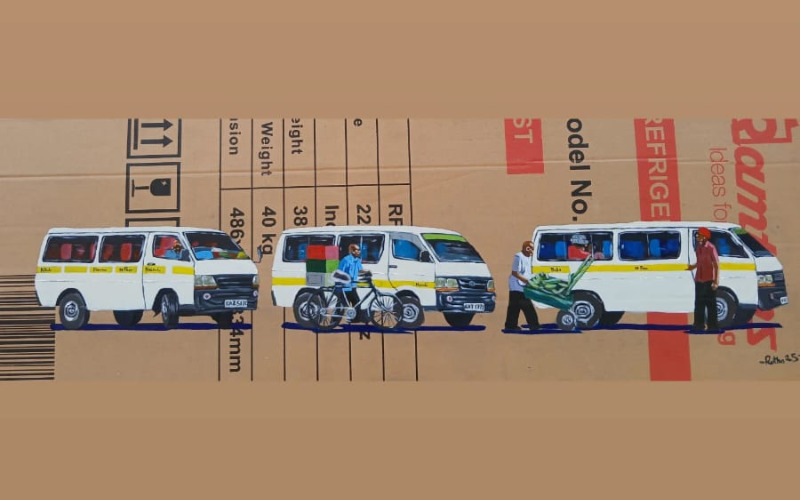
The third body of work, Negative Space, consists of miniature paintings inspired by Maina’s view of Nairobi, particularly its transport system. The series features miniature matatus painted within small sections of the canvas.
The limited use of the canvas reflects his interest in the relationship between individuals and the larger city.

“It illustrates how we are very small in a very big ecosystem and how sometimes we feel we are very small in a very large world. So it talks about Nairobi as a whole,” he says.
The abstracted backgrounds represent the movement and activity of the city, where different things happen simultaneously as people go about their daily lives.
The three series offer a broad view of Nairobi. Rather than focusing on one aspect of the city, he uses different subjects, materials and scales to explore its people and everyday life.
Working on the series has not only changed how he sees Nairobi, but it has also changed how he views the country from a political and economic perspective.
Born and raised in Nairobi, Maina wants to give viewers a different perspective of the city.