

What does a girl see when she looks beyond the grazing fields?
For girls growing up in Northern Kenya, the answer is not always easy to imagine. Livestock, drought, household responsibilities, water scarcity and long distances to school can make education feel like a distant possibility.
Then a door opens.
A uniform is found, fees are paid and a girl leaves home for boarding school. She enters a classroom and encounters a world of teachers, friends, knowledge and possibilities.
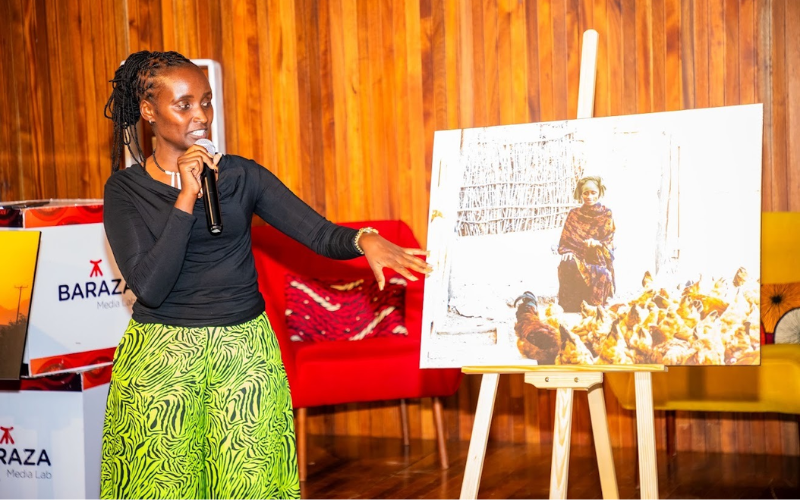
This journey is at the heart of photographer and documentary filmmaker Hildah Kathure’s She Is Rising from the North – Education Works, a photo-book and exhibition launched in Nairobi on September 20.
The project draws from about 15 years of Kathure’s work with girls and young women in Northern Kenya through the MOV Foundation. More than a collection of photographs about education, it is a visual record of becoming.
The book is divided into three sections — On the Grazing Fields, At School and On the Job — tracing the girls from the landscapes where their journeys begin to the spaces they eventually occupy as professionals.

The grazing fields are not simply scenery. They represent the realities many girls navigate: caring for siblings, fetching water, tending livestock and managing household responsibilities while confronting poverty, drought, insecurity and social expectations.
“At school, the narrative changes. Girls begin to encounter new ideas, ask questions and imagine lives beyond their immediate surroundings,” she says.
Zeituna Kunu, a Grade Eight pupil who dreams of becoming a doctor after losing her mother to illness, embodies that emerging possibility. Form Four student Macline Rimpiya draws inspiration from women in her community who have become doctors, teachers and officers.
“At that moment, the photograph becomes more than a record of where she has been”
The book later introduces women such as Dr Zeinab Guracha, CEO of Kenyatta University Teaching and Referral Hospital, and Kamila Abkanu, a veterinary doctor and Acting Director of Livestock in Isiolo County.
Their journeys demonstrate that the distance between the grazing fields and the workplace is not merely geographical. It is social, economic and psychological.
Kathure’s work also shows that education does not end with graduation. A woman’s first salary can pay a sibling’s fees, support parents, meet household needs or open a door for another girl.

That makes the project more than an education story. It becomes a reflection on economic opportunity, social mobility and the power of investment in girls.
The book does, at times, lean into familiar development language, touching on poverty, gender inequality, unpaid care work and access to education. But its strongest moments belong to the photographs and personal stories.
Kathure has said she was not simply photographing girls, but transformation.
And perhaps that is the book’s most enduring idea.
“A photograph freezes a moment, but these lives keep moving. Some have become professionals and leaders; others are still students, carrying dreams that are yet to unfold,” she points out.
The journey comes full circle when former beneficiaries return as mentors and role models. A girl sees another woman and thinks she can do it too.
At that moment, the photograph becomes more than a record of where she has been. It becomes evidence of where she might go.