



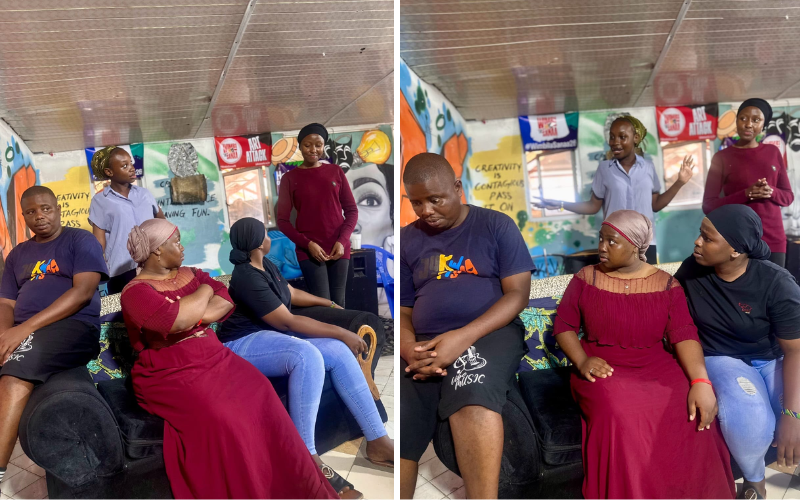
Maji Kichungini is a Swahili drama written by award-winning playwright Mohamed Komeja, produced by award-winning Caroline Ngorobi of Jukwaa Arts Company and award-winning Martin Kigondu of Prevail Presents Ltd.
Directed by Kigondu, the play explores illness, family, legacy, caregiving and the financial and emotional pressures that accompany serious illness.
The play follows Mamu (Mariam Dzungu), a determined entrepreneur who has built a successful company while raising her three children alone. Her carefully ordered life is disrupted when she is diagnosed with cancer, forcing her to depend on the children she has spent years providing for and protecting.
As her illness progresses, Mamu starts to question whether her pursuit of success and financial security has created an emotional distance between her and her children.
She now needs something money cannot provide: their presence, understanding and love. Meanwhile, mounting treatment costs force the family to confront questions of money, responsibility, sacrifice and inheritance.
Beli (Sarah Wangui) becomes her mother’s companion and caregiver, taking over the struggling business. Her strong religious beliefs lead her to hope that prayer can cure Mamu, while her moral judgement creates conflict with her siblings. Mamu’s son, Mose (John ‘Masufuria’ Mumba) anticipates inheriting her wealth, leaving much of the responsibility for their mother’s care and the business to his older sister.
The title is a metaphor for the fragility of life. Maji Kichungini, means “Water in a Sieve”, evokes the image of water slipping through, leaving only residue behind. Komeja says that the image captures how people live as though life will continue indefinitely, even as time moves on.
The story is partly influenced by Komeja’s experience as a cancer survivor. He says thathe sought to maintain a writer’s distance while drawing on his own experiences of treatment.
He acknowledges that the emotions and anxiety of living with cancer, undergoing chemotherapy and surgery inevitably found their way into the writing. However, he was careful not to let his personal experience overshadow the story.
Through Mamu’s illness, Komeja examines how serious illness can alter family relationships. The woman who has always provided emotional and financial support must now depend on her children, who are themselves confronting fear and uncertainty.
“Serious illness does not only attack the body of the patient; it exposes the strengths, weaknesses and unresolved tensions within the family,” he says.
Writing about illness also prompted him to reflect on the importance of relationships to wellbeing. He sees the family as both a source of support and a space where unresolved conflicts can deepen.
For him, it is perhaps the most intimate expression of this complexity.
Komeja’s work draws on experiences ranging from his upbringing in Taveta and life in Nairobi to university activism, adulthood in Norway and his return to his roots.
“Kiswahili is my preferred language of storytelling because it is the language I command most naturally. It gives me the freedom to play with words, rhythms, meanings and expressions as I create,” he says.
He hopes audiences will recognise themselves in the family’s fear, helplessness and attempts to make things right. He also hopes the play encourages people to take early cancer diagnosis and treatment seriously.
“Caregiving is not only about medicine. It is about being present when someone is afraid, listening when they are vulnerable, and reminding them that they do not have to face illness alone,” he says.
The play also represents Komeja’s concerns about the place of Kiswahili theatre in Kenya. He argues that Kiswahili should be understood as the language through which a story is told, rather than a label that limits how the work is perceived.
He believes Kiswahili playwrights should create ambitious, contemporary theatre across genres, from romance and comedy to political drama, tragedy and experimental theatre.