



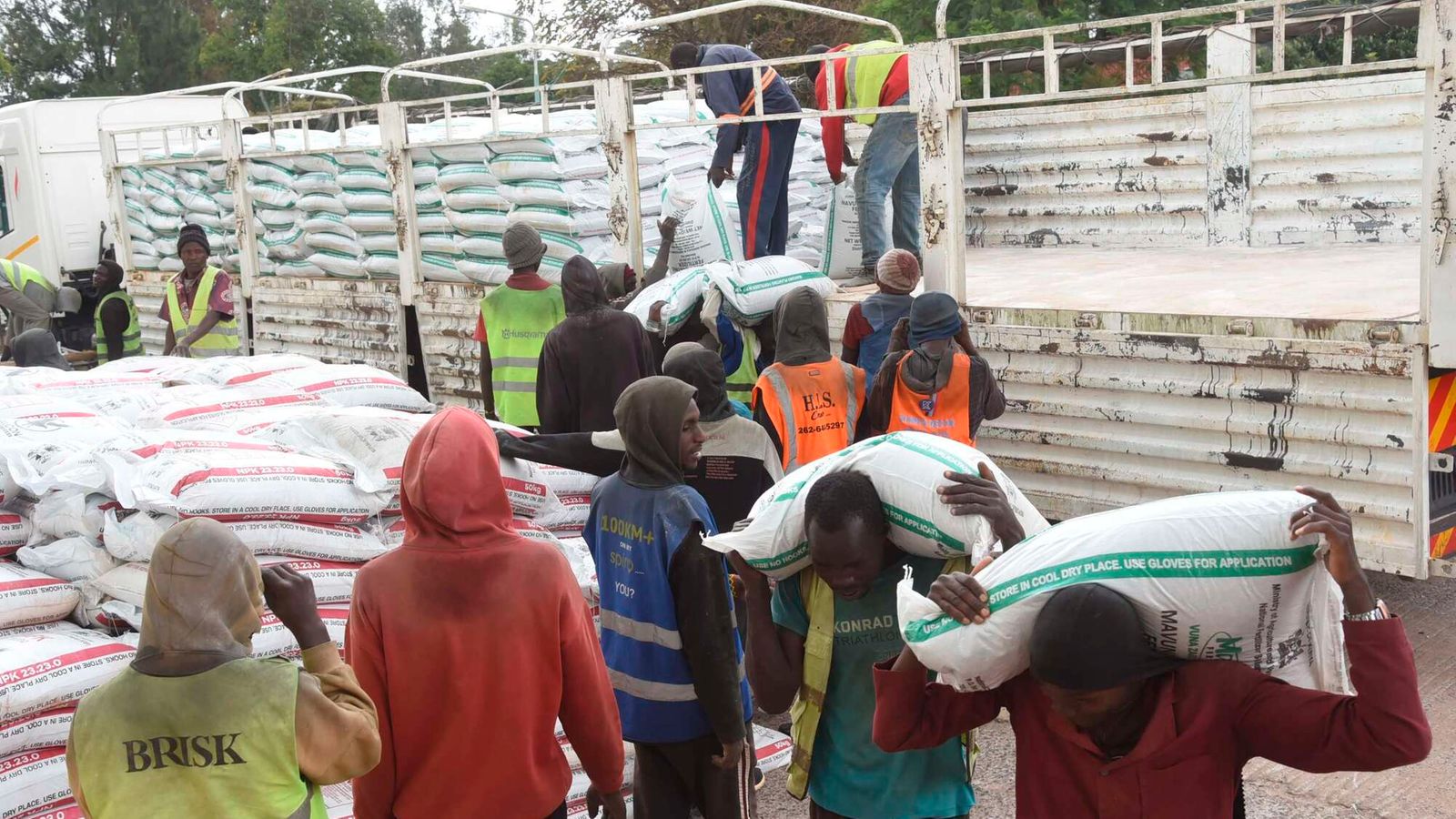


The High Court has faulted the Ministry of Agriculture for allowing the distribution of substandard fertiliser to farmers in 2024, saying the commodity did not conform to the declared specification or applicable standards, in violation of farmers’ rights.
The fertiliser was distributed under the National Fertiliser Subsidy Programme (NFSP), was suspended midway following public uproar and claims that some of the products supplied to farmers were fake.
The court also faulted the government for failing to constitute the Fertiliser and Animal Foodstuffs Board as required by law, saying the failure was unlawful and inconsistent with Articles 10(2)(c) and 129(2) of the Constitution.
“I therefore find that the failure by the office of the Cabinet Secretary for Agriculture to constitute the Board as required by sections 2A and 2C of Cap 345 was unlawful and inconsistent with Articles 10(2)(c) and 129(2) of the Constitution,” Justice Gregory Mutai said.
Also Read: Cartels, loopholes and fake fertiliser: How Ruto’s subsidy programme was hijacked
The judge found that the fertiliser supplied under the programme was of poor quality and fell short of the composition declared on the packaging.
“This court has found that the fertiliser was not of reasonable quality; it fell far short of the composition declared on the bag and of the specification the 4th Respondent had tendered for, and it was confirmed in writing that all of the Kelgreen NPK 10:26:10 it sold was unfit for distribution,” the judge said.
The government rolled out the NFSP in September 2022, under which planting and top-dressing fertilisers were sold to registered farmers at subsidized prices through depots operated by the National Cereals and Produce Board (NCPB).
For the 2024 long rains, NCPB procured several fertiliser products, including NPK 10:26:10 sold under the brand name Kelgreen, manufactured by Kel Chemicals and supplied to NCPB by Mem Distributor Limited.
In March 2024, complaints emerged that fertiliser sold through NCPB depots under the subsidy programme was substandard or counterfeit.
Distribution of the product was halted and the Kenya Bureau of Standards suspended the company’s standardization mark permits.
NCPB officials and representatives of the two companies were subsequently charged before the Chief Magistrate’s Court in Kiambu.
The controversy also reached Parliament, where MPs approved a motion seeking the dismissal of the then Agriculture SC Mithika Linturi. However, a Select Committee to which the matter was referred found the allegations against him unsubstantiated.
Also Read: Alarm as rogue traders sell fake fertiliser to farmers in Rift Valley, Nyanza
The Law Society of Kenya (LSK) subsequently moved to court, challenging the conception, procurement and implementation of the NFSP and seeking a raft of declarations and orders.
LSK argued that the programme had been implemented through agencies that lacked the mandate to do so because the Fertilizer and Animal Foodstuffs Board had never become operational. It also challenged the use of an “extra-legal” monitoring committee, arguing that the arrangement violated the Constitution.
The court heard that police later visited the manufacturer’s premises in Thika, Kiambu County, where samples of three products were collected and found to be substandard. The stocks were subsequently seized.
Justice Mutai said Section 2A of the Fertilizers and Animal Foodstuffs Act, introduced through the Fertilizers and Animal Foodstuffs (Amendment) Act of 2015, establishes the Fertilizer and Animal Foodstuffs Board of Kenya as a body corporate.
Section 2B gives the Board the responsibility of regulating the fertilizer and animal foodstuffs industry, including production, manufacture, packaging, importation and marketing.
Among its duties is advising the national and county governments on the procurement, importation and efficient and timely distribution of subsidized fertilizers; inspecting fertilizers for quality and safety; licensing manufacturers, distributors and retailers; and ensuring that fertilizers imported, manufactured or distributed in Kenya meet prescribed quality and safety standards.
Also Read: How rogue traders made billions from fake fertiliser
However, nearly nine years after the law established the Board, and when the subsidy programme was in its second year, the Board had still not been constituted.
“No reason was given to this Court. The only reason recorded before the Select Committee was that the matter had to go to Cabinet in view of plans to collapse some boards. A policy wish to restructure State corporations does not suspend a statutory duty. Until Parliament amends or repeals section 2C, the duty stands, and an interim administrative arrangement cannot replace it,” the judge said.
Justice Mutai said the Board was intended to be the specialised regulator responsible for licensing fertilizer manufacturers and distributors, inspecting products for quality and safety, and advising the government on the procurement and distribution of subsidized fertilizer.
“Those are precisely the safeguards whose absence the facts of this case expose. I do not suggest that a constituted Board would necessarily have prevented what happened,” the judge said.
He said the prolonged failure, without lawful justification, to establish a regulator that Parliament had specifically created to oversee the fertilizer sector, while at the same time implementing a national programme in the same field, was inconsistent with the Constitution.
Follow our WhatsApp channel for breaking news updates and more stories like this.