

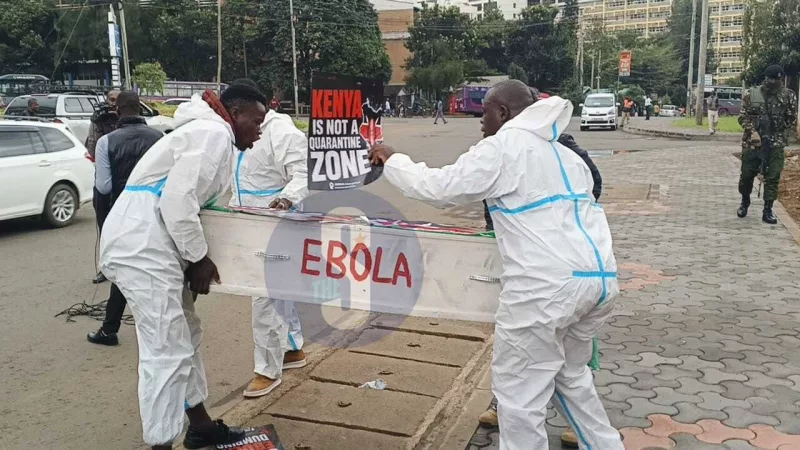
Ebola quarantine facility/HANDOUT
The ebola epidemic in the Democratic Republic of Congo is continuing to grow
in provinces bordering Uganda.
This has raised concern about further cross-border
infections even as transmission shows signs of slowing in some other parts of
the country.
The World Health Organization (WHO) on Friday said Ituri and North Kivu,
which are on the border with Uganda, accounted for all the new cases reported
in the most recent 24-hour period covered by its October 8 update.
Ituri recorded 33 cases while North
Kivu had 30, highlighting the continued concentration of infections in eastern
DRC.
The latest figures came days after Kenya confirmed its first imported case
of Bundibugyo ebola, involving a Kenyan man who had travelled from DRC through
Uganda before arriving in Nairobi. The man was isolated and treated in hospital
but died on October 5.
Kenya has accounted for 66 people who may have come into contact with its
first confirmed imported Ebola patient, who has since died. The contacts have been quarantined at the National Police Service Hospital in Nairobi as the
government intensifies efforts to prevent further transmission.
The Ministry of Health said efforts to trace and follow up with the
remaining contacts were continuing.
The imported case has heightened concern over the risk of the virus
spreading across borders as health authorities in the region work to contain
the outbreak.
According to the WHO report, DRC had recorded 8,728 confirmed cases and
4,205 deaths by October 6, representing a crude case fatality ratio of 48.2 per
cent.
The country had also recorded 2,269 recoveries. The cases had spread across
64 health zones in seven provinces, including Ituri, North Kivu, South Kivu,
Haut-Uélé, Bas-Uélé, Tshopo and Sud-Ubangi.
Since the previous WHO situation report on September 25, the country had
recorded an additional 775 confirmed cases and 379 deaths.
Ituri remained the worst-affected province, with 6,480 confirmed cases and
2,989 deaths.
North Kivu had recorded 1,755 cases and 1,013 deaths, with a
reported case fatality ratio of 57.7 per cent.
The outbreak also expanded into Alimbongo health zone in North Kivu, which
reported four confirmed cases, including two deaths.
This brought the epidemic
into an additional health zone since the previous report.
The WHO said transmission remained intense nationally, but the situation
varied considerably between locations.
“At the national level, transmission remains intense, although the burden is
unevenly distributed. In some areas, there are clear signs the epidemic is
slowing down, although in others it continues to grow,” it said.
The number of new cases reported nationally over the three most recent
completed epidemiological weeks rose by 2.5 per cent, from 475 to 487.
Deaths
reported weekly remained broadly stable, increasing from 222 to 224.
The figures suggest that while the overall outbreak continues to expand, its
trajectory is not the same everywhere.
The increase in cases in Ituri and North
Kivu remains a particular concern because of the continued movement of people
across the region.
The WHO said tracking people who may have been exposed to the virus remained
a major challenge in DRC, with follow-up falling short of the target in recent
weeks.
As of October 4, health teams had reached 23,741 of the 29,535 contacts
being monitored, representing 80.4 per cent coverage against a target of 85 per
cent.
This means thousands of people identified as contacts had not been
reached during the reporting period.
The organisation also raised concern about the number of people dying
outside treatment centres, which could indicate delays in detecting the disease
and accessing medical care.
“Since the last Disease Outbreak News, 264 of the 372 reported deaths
occurred in communities and 108 in treatment centres,” the WHO said.
“The persistently high
mortality, together with the large number of deaths occurring outside treatment
centres, continues to point to delays in identifying illness and reaching
appropriate care.”
The outbreak has also affected healthcare workers.
On October 1, the
Netherlands reported the medical evacuation of a health worker who had tested
positive for Bundibugyo virus while working in DRC.
The patient was receiving
treatment in the Netherlands, according to the WHO.
Kenya has intensified surveillance following the imported case, including
efforts to identify people who had contact with the patient and passengers who
travelled on the same flight.
The Health ministry said more than 652,000 travellers had been screened
since the outbreak began, while 267 samples had been tested through the
national laboratory network by October 7.
The government has also identified
facilities equipped to isolate and manage suspected and confirmed cases.
The WHO said the risk remained particularly high for countries sharing land
borders with DRC, while the risk to the rest of Africa and the world was
assessed as low.
It advised against travel or trade restrictions against
affected countries.
Bundibugyo virus disease is a severe form of Ebola spread through direct
contact with the blood or other body fluids of infected people, or contaminated
materials.
There is currently no approved vaccine or specific treatment for
this strain, making early detection, isolation, supportive care and contact
tracing central to controlling the outbreak.
Instant analysis
Surging Bundibugyo Ebola cases along the DRC-Uganda border, coupled with low contact-tracing coverage, underscore severe cross-border transmission risks. Kenya’s isolation of 66 contacts following an imported fatality reflects high regional vulnerability. With a 48 per cent fatality rate and no strain-specific vaccine, strict border surveillance and rapid contact tracing remain paramount.