

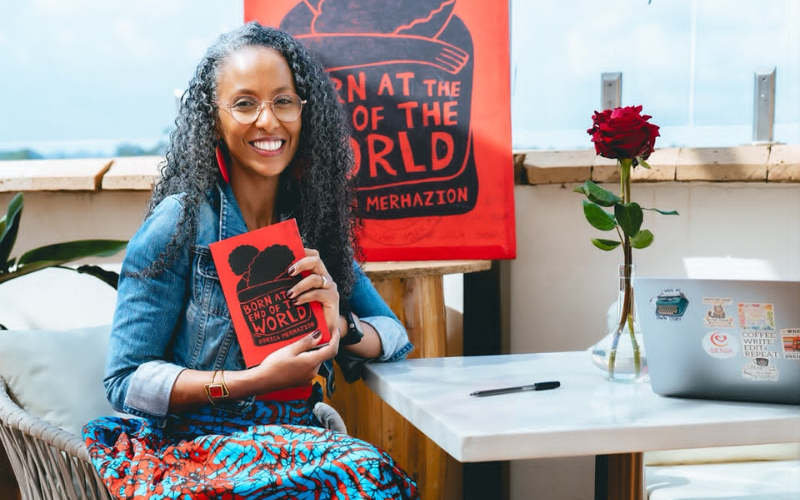
Donica Merhazion’s debut novel, Born at the End of the World, draws on her family’s experiences during Ethiopia’s Red Terror and the struggle for Eritrean independence.
Born in Addis Ababa in 1979, Merhazion came into the world in Alem Bekagn prison, where her mother was imprisoned for her involvement in the struggle for Eritrean independence. Both her parents were freedom fighters.
A former journalist and now a teacher, Merhazion has lived in Ethiopia, Eritrea, Kenya, Zambia and the United States. Her writing draws on personal and collective histories, exploring love, courage, memory, freedom and survival.
In Born at the End of the World, Ellen, a 13-year-old Ethiopian girl, leaves her village for Eritrea with her friend Brikiti to escape an arranged child marriage. Her journey becomes a search for freedom from both the circumstances of her own life and a wider political struggle.
The novel also follows Girmai, an orphan whose life is marked by loss, abuse, hunger and homelessness. After his father’s death and abuse from his stepmother, he leaves his village. In Asmara, he is chased away by municipal officers while hawking in the streets before his cousin helps him find a place to sleep and teaches him to knit.
Though the novel is historical fiction, its characters and experiences are closely connected to Merhazion’s family history. Ellen is inspired by her mother, while Girmai’s story draws from her father’s experiences.
Ellen’s decision to leave home at 13 is central to the novel. Merhazion says that her age is significant because her childhood experiences help explain the choices she makes later in life. Her journey to Asmara represents an attempt to free herself from oppression, while freedom itself exists at both an individual and national level.
“The story began as something I wanted to leave for my three children. I wanted them to understand my experiences and those of their grandparents and to know where they came from. What began as an essay to my children grew into a novel,” she says.
Merhazion had always loved writing, but after the birth of her first child, now 25, she began thinking about telling the story of his grandparents.
She started writing the book about eight years ago, working on it intermittently.
She chose historical fiction because it allowed her to recreate the past in a way that reflected how she experienced her parents’ accounts.
“I felt the story was really dry and my parents are dynamic storytellers. I didn’t want to tell it in a linear way. I have recreated conversations,” she says.
Alem Bekagn prison, where Merhazion was born, no longer exists. The site is now home to the United Nations headquarters in Addis Ababa.
The prison was used during the Derg era to detain political dissenters. Haile Selassie was overthrown in 1974 by the military government known as the Derg, which became increasingly violent in its suppression of dissent. People suspected of opposing the government were imprisoned, tortured and killed.
Merhazion says her parents became involved in resistance to the regime.
Growing up, she heard stories about the period from her parents and their friends. Researching the novel showed her that the scale of the violence was greater than she had understood as a child.
The experience reinforced her belief in the importance of knowing one’s history, particularly for young people separated from their countries of origin through displacement.
“Knowing your history can ground you. A tree with deep roots doesn’t have to fear the wind,” she says.
Merhazion came to Kenya with her mother when she was about a year and a half old. They lived in Kenya as refugees until Eritrea gained independence. Growing up in an English-speaking country while carrying Ethiopian and Eritrean heritage shaped her understanding of identity as something continually evolving.
She remembers her parents welcoming people fleeing wartime situations and says their example taught her the value of service, justice and peace. Her connection to Eritrea remains an important part of her identity, particularly its traditions of community and care.
Being born in prison has also given her a connection to her parents’ history, although she has no memories of the prison itself.
Instead, she remembers how her parents raised her and the values they passed on.
One childhood experience made her particularly conscious of how personal histories can be received by others. In Grade Three, she told her classmates about her parents’ involvement in the freedom struggle. They laughed at her, leaving her reluctant to share her story.
As an adult and teacher, she has tried to ensure children do not become disconnected from their own experiences because of such reactions. Knowing who you are and where you come from, she says, can be powerful.
Merhazion studied journalism because of her love of writing before moving into teaching, drawn by a desire to work with children.
Teaching has become another way for her to use storytelling, and she says children teach her as much as she teaches them.
She holds a BA in Journalism from the University of Asmara and an MA in General and Special Education from the University of Maryland.
She hopes young readers, including children of freedom fighters, will finish the book wanting to discover their own family histories.
The novel is a way of honouring her parents, but she also sees their story as part of a history belonging to people who never had the opportunity to tell their own experiences.
“It is such an honour and privilege to tell their stories. I hope it represents those who were not able to tell theirs,” she says.