



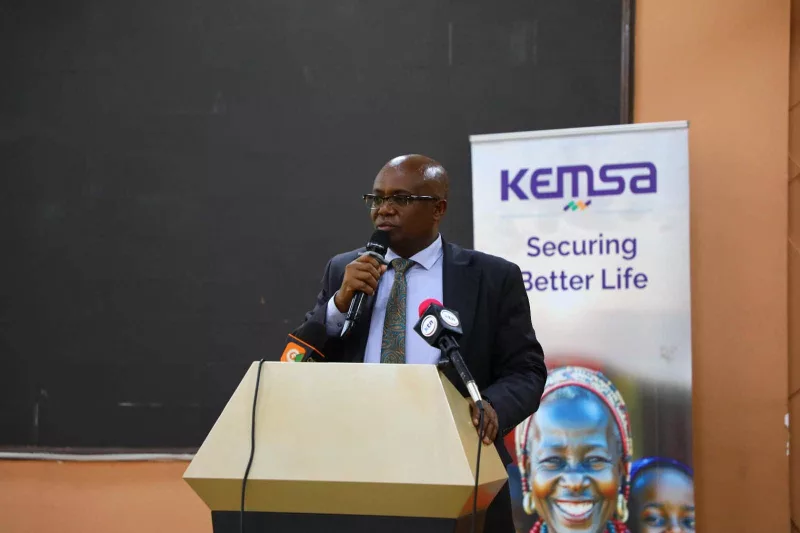
The Kenya Medical Supplies Authority (Kemsa) has called on hospital pharmacists to play a greater role in procurement planning to help prevent medicine shortages, reduce wastage and ensure health facilities receive supplies when patients need them.
KEMSA Chief Executive Officer Dr Waqo Ejersa said better coordination between the agency, county governments and national referral hospitals was essential to improving the availability of health products and technologies (HPTs).
Speaking during the Joint KEMSA, County and National Referral Hospitals Pharmacists Conference at Lake Naivasha Resort on Monday, Ejersa said procurement decisions must be informed by actual hospital needs, consumption patterns and accurate demand forecasts.
“The availability of HPTs is not determined by procurement alone,” he said, noting that clinical needs, demand forecasting, distribution and prudent use of resources must work together.
He urged pharmacists to share timely information on stock levels, medicine consumption and emerging patient needs to help KEMSA make informed purchasing and delivery decisions.
“We must therefore move from simply responding to orders to anticipating demand together,” Ejersa said.
The conference, running from October 11 to 15, 2026, brings together pharmacists and health sector stakeholders to discuss ways of strengthening supply chain management and improving service delivery.
Ejersa said KEMSA was using market intelligence, product utilisation, supplier capacity, pricing and emerging risks to guide procurement decisions and ensure value for money.
He said pharmacists’ experience at the point of care should inform product selection and purchasing priorities.
The CEO also warned against wastage caused by expired and slow-moving medicines, urging hospitals to improve quantification, share information on short-dated stock and harmonise product specifications where clinically appropriate.
“Every shilling matters. Every expired product represents resources that could have served a patient elsewhere,” he said.
He added that new health products and technologies should be assessed based on their clinical value, affordability and evidence of need.
Ejersa said the authority would also embrace technology to improve stock visibility, traceability and forecasting, enabling health facilities and suppliers to respond before shortages occur.
“Ultimately, this is not just about procurement systems or inventory figures. It is about ensuring that no patient misses essential treatment because we failed to anticipate, plan or act,” he said.
On financing, Ejersa said KEMSA had established tripartite arrangements with participating Level Six hospitals through the Social Health Authority to support a more structured approach to financing health products and technologies.
The arrangements include agreed receivables and deduction-at-source mechanisms intended to improve predictability in supply, payment and replenishment.
However, he cautioned that financing arrangements must be supported by sound demand planning, timely collections, responsible ordering and effective inventory management.
As the conference concludes, KEMSA wants participants to agree on a validated HPT product list, harmonised specifications, prioritised new product requirements, recommendations for rationalisation and reliable quantities to guide procurement planning for the 2026/27 financial year.
Ejersa said the authority would work with county governments and health facilities to translate the recommendations into decisions on procurement scheduling, restocking, redistribution and allocation of financial resources.
He urged stakeholders to maintain regular information-sharing and jointly review supply challenges to build a more responsive and resilient health supply chain.