



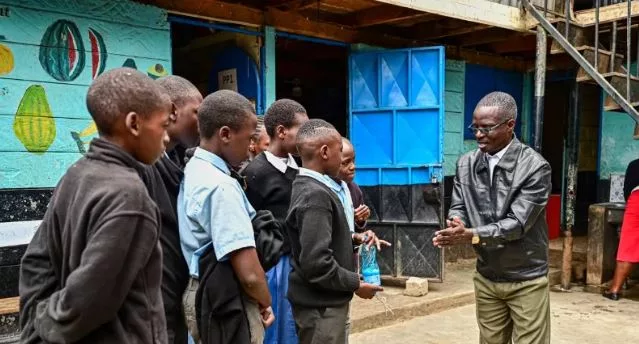
Joyspring Educational Centre Headteacher George Onyango showing students how to wash hands. The school is a beneficiary of SHOFCO’s WASH programme./HANDOUT
For years, Mildred
Akinyi, a resident of Kibera, paid little attention to messages from community
health promoters urging residents to handle water safely, wash their hands
regularly and maintain proper sanitation in their homes.
But it was not
until illness struck that she began to appreciate the consequences of
neglecting basic hygiene practices.
Akinyi fell ill
and spent four days at Mbagathi Hospital, where she was treated for cholera in
2023.
“I used to see
Shofco community health promoters moving around, telling us to wash our hands,
treat our drinking water and keep our surroundings clean. Sometimes, I would
listen and go on with my life because I did not think these things could affect
me personally,” she says.
Akinyi is now
among 200 community health promoters engaged by Shining Hope for Communities
(Shofco) to promote safer hygiene practices and prevent the spread of
waterborne and other diarrhoeal diseases in Kibera.
As the world
prepares to mark Global Handwashing Day on October 15, the experience of
residents such as Akinyi highlights the importance of turning hygiene awareness
into practical action in communities where access to sanitation services
remains a challenge.
Shofco says it has
reached 81,696 through Social and Behaviour Change Communication (SBCC) on
sanitation between January and September 2026. The organisation is also working
with 65 schools and 15 health facilities to strengthen hygiene education and
infection prevention.
Nicholas Mutia,
Kibera Sub-County Infection Prevention and Control Coordinator, says health
records show a notable reduction in cases.
Between January
and June 2026, the sub-county recorded 527 diarrhoeal cases. From June to the
end of September, a further 123 cases were recorded.
“We are closely
monitoring the numbers because diarrhoeal diseases can spread quickly in
densely populated communities. The figures we are seeing are encouraging, and
hygiene awareness has an important role to play in preventing infections,”
Mutia says.
He attributes the
progress to hygiene awareness activities spearheaded by Shofco and the 15
health facilities serving the area.
Dr Kennedy Odede,
Shofco’s founder and chief executive, says there has been urgent need for
Shofco to scale up water, sanitation and hygiene (WASH) services for the past
two years following the exit of USAID-funded programmes that previously
supported interventions in Kibera.
“Our decision to
sustain and expand WASH activities in Kibera was informed by the progress
communities had made, particularly in the fight against cholera. We could not
afford to watch those gains disappear because programmes that supported
essential services had ended.
“Since 2023, no
cholera cases have been reported in Kibera, and protecting that progress must
remain a shared priority,” Odede says.
The organisation
currently serves 55,000 people with clean aerial piped water in Kibera.
John Musau, Kibera
Sub County WASH Coordinator, says Shofco and local health officials have established Village Sanitation Committees,
formed health clubs in 65 schools, supported health talks in 15 health
facilities and organised community clean-ups.
“Following the
exit of USAID-funded programmes, there was a real risk that some of the
progress made in sanitation and hygiene would be lost. Shofco’s continued
support has helped us maintain activities that are essential to protecting
public health,” Musau says.
He says Village
Sanitation Committees are helping communities take responsibility for their
surroundings, while school health clubs are teaching children habits they can
practise at home and carry into adulthood.
Francis Odera,
chairman of Community Health Promoters in Kibera, says they have made progress
in teaching residents the importance of collecting and disposing of rubbish
rather than allowing it to accumulate around homes and public spaces.
He, however, warns
that the absence of an adequate dumping site remains a major obstacle, leaving
residents and community teams with limited options after collecting waste.
“We need the
government to provide a proper dumping site and reliable waste collection in
Kibera. Community education will only achieve so much if the infrastructure
needed to maintain cleanliness is missing,” he says.
At Joysprings
Educational Centre, headteacher George Onyango says support from Shofco has
helped the school improve water access, hygiene education and ablution
facilities.
“Handwashing was a
challenge because we did not always have enough water. Even when children knew
they needed to wash their hands, it was difficult to make that a consistent
practice.
“We are seeing
improvements in attendance, and we believe that keeping learners healthy is an
important part of ensuring they remain in school,” he says.