

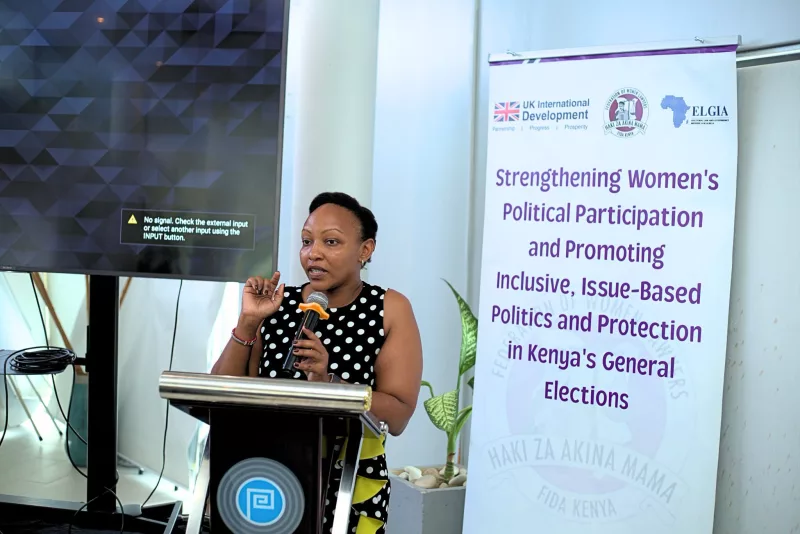
The Federation of Women Lawyers in Kenya (FIDA-Kenya) has urged political parties to strengthen their internal systems and invest in women aspirants ahead of the 2027 general election.
FIDA-Kenya chairperson Christine Kungu said parties should build the capacity of women, youth and Persons with Disabilities (PWDs) league representatives to promote fair and inclusive participation.
Kungu said FIDA-Kenya has been engaging political parties on gender-responsive election and nomination rules, women’s leadership, inclusive decision-making and measures to prevent sexual harassment, political intimidation and Technology-Facilitated Gender-Based Violence (TFGBV).
She cited an engagement in Kisumu county on October 7, which highlighted limited capacity among women aspirants and league representatives to navigate party structures, understand nomination procedures and advance women’s representation.
“Women aspirants and representatives of party leagues have limited capacity to navigate party structures, understand nomination procedures and effectively advance women’s representation,” Kungu said.
She said this points to the need for practical support that equips women with knowledge and skills to participate in party decision-making, pursue elective positions and understand processes for addressing nomination-related grievances.
Kungu cited the Independent Electoral and Boundaries Commission (IEBC) Women’s Political Participation and Leadership Final Report: Kenya Assessment, published in 2023, which found that women accounted for only 12.18 per cent (1,962) of the 16,100 candidates cleared to contest in the 2022 general election.
The report identifies persistent social and institutional barriers that undermine women’s political participation and leadership.
On TFGBV, FIDA-Kenya’s Election Sexual Gender-Based Violence (ESGBV) report of 2022 found that 52 per cent of SGBV cases documented across Kenya involved online violence.
Kungu said the constitution provides a clear basis for action, citing Article 27 on equality and freedom from discrimination, Article 81(b) on the two-thirds gender principle, Article 91 on basic requirements for political parties, and Article 100 on promotion of representation of marginalised groups.
She said political parties have an opportunity to translate these obligations into practice as they prepare election and nomination rules for the 2027 cycle.
The Office of the Registrar of Political Parties (ORPP) has set October 16, 2026 as the deadline for submitting the rules, with certification expected by October 30 and submission to IEBC by November 6, 2026.
“Strengthening women’s political leadership requires more than formally opening opportunities to contest. Women must have the knowledge, practical support and institutional backing needed to navigate party processes and compete fairly,” Kungu said.