

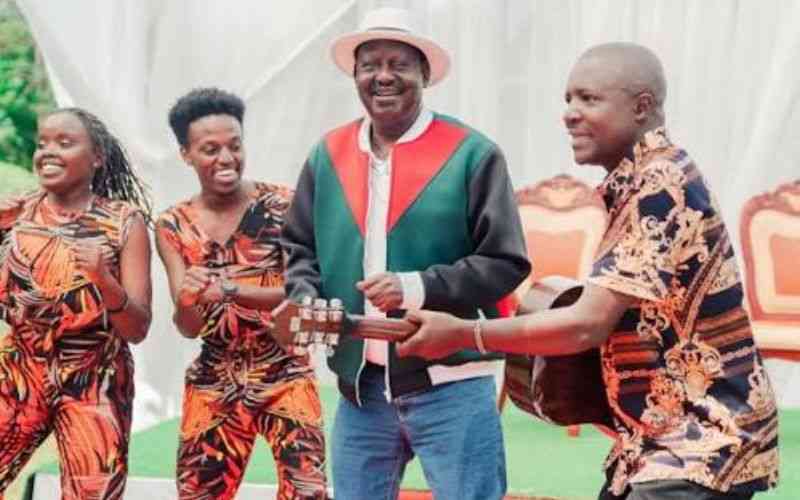
As Kenyans marked one year since the death of former Prime Minister Raila Amolo Odinga on October 15, 2025, the songs associated with his campaigns remain a striking testament to how the political enigma’s identity blended effortlessly with Kenya’s entertainment scene.
From the “NASA Tibim” chant to “Leo ni Leo”, campaign songs reached audiences far beyond political rallies, bringing musicians, dance and popular rhythms into Kenya’s electoral contests.
Raila died in India aged 80, ending a political career that spanned decades. As Kenyans reflect on his life, the music that accompanied his campaigns provides another way of tracing his journey through the artists, recordings and performances that became part of his public image.
Raila’s campaign music legacy dates back to 2002, when Gidi Gidi Maji Maji’s hit “Unbwogable” became an anthem for the National Rainbow Coalition (NARC), the opposition coalition that brought Mwai Kibaki to the presidency.
Performed by Kenyan hip-hop duo Joseph Ogidi (Gidi Gidi) and Julius Owino (Maji Maji), the song popularised the term “Unbwogable”, meaning unstoppable or impossible to intimidate. The phrase captured the mood of supporters calling for political change.
Raila was a key figure in NARC and among the leaders who backed Kibaki’s presidential bid. Although “Unbwogable” was not originally written as a campaign song, it became closely associated with the coalition, showing how a popular hit could acquire political significance and become part of an election’s identity.
By 2007, the music accompanying Raila Odinga’s presidential ambitions had become more personalised, with songs celebrating him and the Orange Democratic Movement (ODM).
Ohangla musician Onyi Papa Jey, whose real name is Bernard Onyango Ranginya, released “Raila ODM”, a track celebrating Raila and his party. Blending Luo and Swahili lyrics with references to ODM’s political journey, the song featured the chant “Mnataka nani?” (“Who do you want?”), followed by “Chungwa!” (“Orange!”), a reference to ODM’s symbol that encouraged supporters to join in. The song became part of the musical backdrop to Raila’s presidential campaign that year.
By 2017, campaign music had become a prominent feature of Raila Odinga’s presidential bid under the National Super Alliance (NASA). Ohangla musician Onyi Jalamo’s “NASA Tibim” became one of the coalition’s signature campaign anthems, with the chants “Tibim” and “Tialala” catching on among supporters.
The energetic track featured at NASA rallies, where crowds sang and danced along. Its popularity showed how campaign music could travel beyond political gatherings, with chants entering everyday conversation and becoming part of Kenya’s wider popular culture.
Gospel musician Hellenah Ken’s “Mambo Yabadilika”, meaning “Things Are Changing”, was also associated with the NASA campaign, echoing the coalition’s message of political change. Together, the songs and chants helped shape NASA’s campaign identity, turning rallies into performances that blended political messaging with entertainment.
During his final presidential bid in 2022, Raila took a more direct role in campaign music, teaming up with Benga musician Emmanuel Musindi on “Lelo ni Lelo”, a rendition of Musindi’s original hit.
Released in February 2022, the campaign version featured Raila performing alongside Musindi as he sought the presidency under the Azimio la Umoja coalition. The title translates to “Today is the day”, a phrase that captured the campaign’s call to action.
Raila opened the track with his trademark “haya haya” phrase and repeated “Inawezekana”, meaning “It is possible”, and “Kenya mpya inawezekana”, which translates to “A new Kenya is possible”. Both phrases were associated with his campaign messaging.
He also sang lines from Kenya’s national anthem, including “Haki iwe ngao na mlinzi” and “Natukae na udugu”, drawing on the anthem’s themes of justice, unity, peace and freedom.
The accompanying video showed Raila performing alongside musicians and dancers, placing him at the centre of a production that blended political messaging with popular entertainment. The collaboration also demonstrated how campaign songs could reach voters beyond rallies through recordings and digital platforms.
Away from campaign stages, Raila had a musical side that extended to reggae, international classics and contemporary Kenyan music.
One of the songs most closely associated with him was Harry Belafonte’s “Jamaica Farewell”. Raila sang the song during high-profile television appearances, including a light-hearted appearance on The Churchill Show in 2014, when he performed verses as the studio audience cheered.
The song held personal significance for Raila, recalling memories of his youth and family life. In a 2017 interview with then-KTN journalist Betty Kyallo, he revealed that he and his wife, Ida, had planned to spend their honeymoon in Jamaica but could not afford the trip at the time.
“Ida is a geographer and she came to love the Caribbean while I loved Belafonte who is my favourite musician,” he said. “So when we got married we wanted to go to Jamaica but we did not have money so we agreed that we would go one day.”
The couple eventually visited the island with their children after they had grown up.
Following Raila’s death on October 15, 2025, the song took on added significance. Its themes of departure and longing resonated with mourners, while the familiar melody featured in tributes to the former prime minister.
Reggae was another pillar of his musical identity. Lucky Dube’s “Nobody Can Stop Reggae” was among the tracks associated with his appreciation of the genre. Its message of persistence also drew parallels with Raila’s lengthy political career, which included repeated presidential bids and years in opposition.
His musical preferences also included local artists. During his 2014 appearance on The Churchill Show, Raila named “Fundamentals” by Kamba Benga musician Ken Wa Maria among his favourite songs.
He also spoke about his appreciation for Jaguar’s “Kigeugeu”, citing its melody and message as the reasons he liked the song. When asked what he liked about it, he responded: “I like the melody and the message.”
These choices offered a glimpse of a more personal side of a politician whose public life was often dominated by political contests, speeches and calls for reform.
Some songs and chants associated with Raila were closely linked to political struggle. “Bado Mapambano”, meaning “the struggle continues”, became a familiar refrain at rallies and opposition gatherings. The phrase reflected the determination of supporters who believed their political demands remained unresolved.
Another was “Sitarudi Nyuma”, meaning “I will not retreat”, which Raila and his supporters sang during political demonstrations. The chant featured during opposition protests in March 2023, when demonstrators faced police restrictions and tear gas.
Its significance lay not only in the words but also in the circumstances in which it was sung. Repeated by crowds, the chant offered a shared expression of defiance and solidarity without the need for formal speeches.
Together, such songs and chants moved between political mobilisation, protest and public expression, becoming associated with defining moments in Raila’s career.
Raila’s death on October 15, 2025, gave some of the songs associated with his life new significance. Music that had accompanied campaigns and public appearances became part of the tributes and reflections that followed his passing.
Released in 2014, Lady Maureen’s “Raila Duogie Dala”, whose title translates to “Raila, come home”, was inspired by Raila’s return to Kenya after a three-month stay in the United States following the 2013 presidential election. Eleven years later, following his death, the song acquired a different meaning, with its plea for him to come home resonating with mourners confronting his permanent absence.
The songs served different purposes. Some rallied supporters, others expressed political defiance, while a few revealed his musical tastes beyond the campaign trail. Together, they illustrate how music can accompany political movements, shape public gatherings and preserve memories long after the events that inspired it.
Raila’s political journey was documented through speeches, elections and public appearances. It was also carried in melodies, chants and performances that brought politics into Kenya’s entertainment culture.
One year after his death, that soundtrack remains part of how many Kenyans remember the man whose rallies often became occasions for music and dance.