

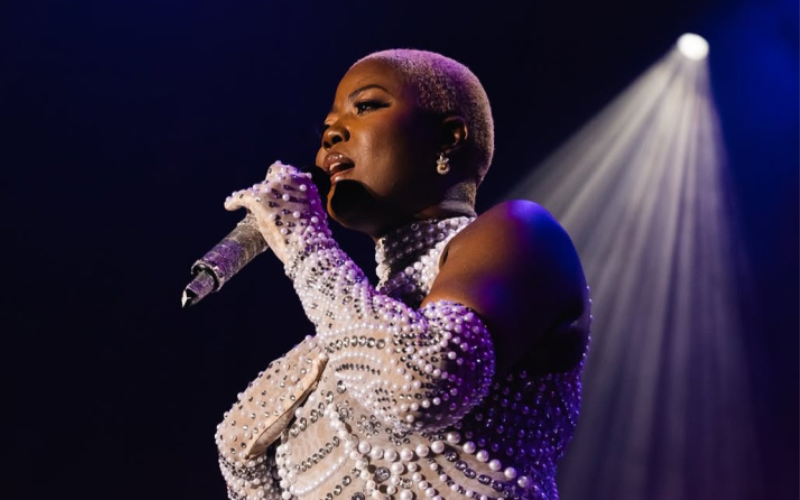
Renowned Congolese songstress Candy Nkuku, popularly known as Cindy Le Cœur, has established herself as one of Central Africa’s most celebrated rhumba and lingala voices, admired for her soaring soprano and refined stage presence.
Her story, shaped by spiritual beginnings, artistic transformation, and a long-discussed partnership with Koffi Olomidé, reflects a two-decade journey that has firmly anchored her in the Congolese and wider African music scene.
The fourth of four children in a close-knit family in Kinshasa, she grew up immersed in the music of Céline Dion and Whitney Houston, whose powerful vocals strongly influenced her early artistic direction.
Encouraged by her parents, she enrolled at the National Institute of Arts (Institut National des Arts, INA) in Kinshasa, where she refined her vocal technique and formally committed to music as a career.
Her early industry experience began in gospel, performing alongside Christian artist Kool Matopé in the early 2000s.
Her breakthrough came in 2006–2007 when she joined Koffi Olomidé’s Quartier Latin International, first as a vocalist and later as artistic director, contributing to a sound that fused Congolese rumba, soukous rhythm, and Afro-pop influences.
Cindy’s solo career gained momentum in the late 2000s and early 2010s with tracks such as “Eputsha,” “Je Te Jure,” “Chemin de la vie,” and “Djino,” which highlighted her range across love ballads and socially conscious themes.
Her breakout hit “Ikia” became a continental success, broadening her audience and earning her the Kora Award for Best Female Artist in Central Africa in 2014.
Her self-titled seven-track album, released in 2013, further cemented her status as a standalone artist rather than solely a featured voice within Quartier Latin, where she had been a leading female presence contributing to five albums, including the popular “Bord Ezanga Kombo.”
“I used to think that one day I would sing with him or make a film with him, where he would play either my father or my husband. Today, I’m experiencing so much more than that. I think it was all meant to be. It’s destiny.”
“At first, in Quartier Latin, the guys had a hard time accepting me. Maybe that was the mentality of Congolese musicians…I’m a strong woman. I didn’t come here to give others a chance. That’s just how I am; when I arrive somewhere, I have to make it my own,” she said in an interview with Ingrid Kabongo TV.
Over the years, she has accumulated multiple accolades, including “Best Female Artist in the Democratic Republic of the Congo” and the “Best of Generation” honour at Zénith Paris in 2009.
In 2014, she also won the Kora trophy, reinforcing her position as a leading woman in a male-dominated industry, following in the footsteps of pioneers such as Faya Tess, Mbilia Bel, Yondo Sister and Tshala Muana.
Beyond awards, her influence has helped reshape how younger Congolese and African audiences perceive so-called “old school” music, bridging tradition and modern sound.
She has collaborated with major names, including Fally Ipupa, Werrason and Kool Matopé, strengthening her footprint in the wider Congolese music industry. She is now officially married to her long-term partner, Lingala maestro Antoine Christophe Agbepa Mumba, popularly known as Koffi Olomidé, 69.