

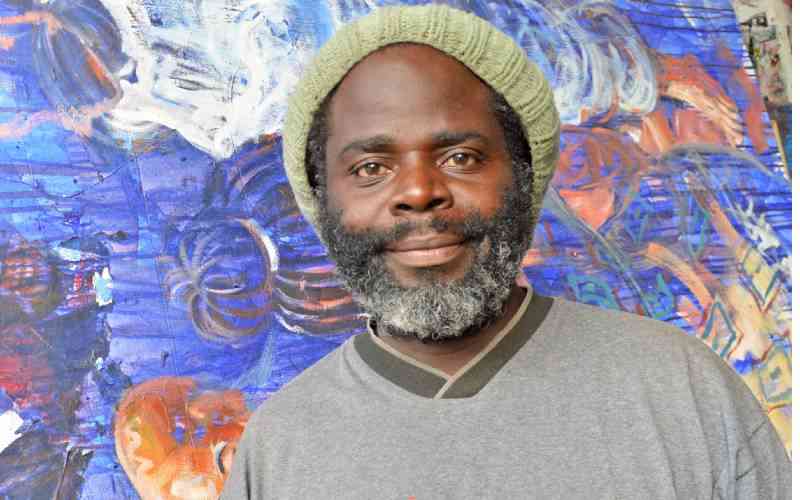
Since we must pay tribute to the legacy of Patrick Mukabi, Maisha Yetu decided to do it a bit differently. We got in touch with a number of people, mostly in the art world, and who interacted with Mukabi in one way or the other, and asked them to remember him.
One thing came out quite clearly: Panye had a passion for mentoring young artists.
Below are some of their observations:
James Murua: Literary blogger
The death of Patrick Mukabi is a huge loss for the Kenyan art scene. His art, most famously seen at the Java Restaurant chain, showed Kenyan people in their natural environment. He proved that one could make a living from art. He also trained a large number of young people who would go on to become the next generation of art producers or art consumers.
His was hyper realistic art which showed Kenyan people as humans in their element. While many artists would cater to international tastes, he produced work for people who looked like him, which is why we responded so viscerally to his work.
Now that he is gone, we should consider having exhibitions of his work annually. I would also love to see someone do a documentary of his work so that those who took part in his journey could be recognised and those who didn’t know him to know the extent of his influence
Thom Ogonga: Visual artist
Patrick Mukabi’s loss is immense to the Kenyan art scene. He has been directly mentoring artists since I joined the art scene circa 1997 and has never stopped. Mukabi is arguably responsible for the second highest number of artists in circulation after the now defunct Creative Art Centre. Most artists get prominent and isolate themselves, but Mukabi used that as a platform for people to access him and tap into his knowledge.
I was privileged to have known him both as a colleague and friend. I worked on numerous projects with him and we travelled a lot together. Images in Transit is probably our favourite project together. We did the first in Nairobi, in 1997 along Agha Khan Walk, and the second at the Likoni Ferry, Mombasa in 2001. In both, we did a different painting every night for 30 days and the public would wake up to a different topic of discussion every morning.
We also had a series of provincial artist training workshops, sponsored by Kuona Trust, to introduce and incorporate artists from outside Nairobi into the mainstream.
Panye was an all-rounder and was brilliant across numerous media. What most people don’t know is that he was an excellent printmaker and sculptor but over time chose to explore drawing and painting.
To honour his legacy, we should start by acknowledging his personal achievements as the brilliant artist that he was, followed by recognising the role he played in nurturing multiple generations into the mainstream art circuit.
Maddo: Veteran cartoonist
I shall always remember Panye as a very cool guy from the days we shared space at the original GoDown Arts Centre. His image was that of an unmistakable artist.
His art was focused and not all over the place. This is mostly why his works adorn prestigious public spaces. He was noticeable. His art stands out as a bold statement to society.
Mukabi’s paintings are masterpieces that will definitely defy passage of time.
King Dodge: Visual artist
The Kenyan art scene has lost one of its greatest creative artists. A selfless mentor who was always ready to share his gift with young and upcoming artists which, of course, is divine oriented. I will always remember him when he supported me twice when I single-handedly organized an exhibition at the Railway gallery, where he was the curator.
He was also a great supporter of Ngecha artists. I loved his paintings, especially those of Nairobi Bar night scenes; they portrayed an artist concerned with women rights. He is an icon worth a monument in the field of Kenyan art. I wish we had a national art gallery where we would dedicate a corner for his priceless talent for future generations to learn and emulate!
Michael Soi: Visual artist
The loss of Patrick is huge. Patrick Mukabi’s influence in the lives of numerous young artists can not be quantified. I want to compare him to the founder of Kuona trust, Rob Burnet, who created, single handedly, a generation of young artists in the mid 90’s. The only other person to repeat that accomplishment was Patrick Mukabi. There are thousands of young artists in Kenya who owe their practice to Panye.
Panye was the guy who welcomed me to Kuona in November 1995. As a young and broke artist, Panye was generous. He had already started selling work and he was wealthier than most of us. He would literally buy paint that everyone in Kuona would use. His generosity knew no bounds.
Panye was a painter, a good one at that. He was a teacher too. He taught painting. Anyone who went through Mukabi should know they studied under a master.
Tabitha Wathuku: Visual artist
With the death of Patrick Mukabi, art mentorship has suffered big time.
On most exhibition evenings, about 30 years ago, I would walk from the Museum with Patrick and my little daughter, Shiko. (Shiko was probably the one who nicknamed him Panye as they chased each other on empty Nairobi streets). He always made sure we boarded a matatu before he took his home.
I used to tease him, suggesting that he went around looking at ‘gifted’ women whose round figures were displayed on his canvas. I probably think the women featured in his art represented his late mum, a nurse, who, like me, was an alumni of Loreto Limuru. I own two of his paintings, which remind me of an artist with a warm heart.
Maggie Otieno: Visual artist (sculptor)
Losing Panye is like losing an institution; a big, important and successful institution. The number of young artists currently enjoying successful practice as full-time artists thanks to Mukabi is huge as those churned by art institutions like Kenyatta University (KU) and BIFA. He single-handedly supported young artists in his Dust Depo establishment with hardly any support from donors.
My fondest memories of him is how he called himself supuu, how he walked barefoot, how he loved freely and gave himself and his passion freely.
Panye epitomised women in his work in such a beautiful way. He showed us their best parts, hard at work in the market, carrying water, washing clothes, talking and laughing, dressed in their shukas with curvy hips and slim waists. He wanted us to remember the beauty of the African woman.
Panye set up an art outfit by the name Dust Depot, which has nurtured so many wonderful and succesful artists.
Lydia Galavu: Curator at the National Museums of Kenya.
Mukabi was not just an artist, he was a pillar in the community. You felt his presence, not only through his paintings but also through the artists he supported and guided. His absence leaves a real gap, especially in mentorship. There are many artists today who grew because he believed in them, and that kind of generosity is not easy to replace.
What stands out most for me about Mukabi is how present he was for his mentees. If one of them got an exhibition at the museum, he didn’t just congratulate them and move on, he would drive them to deliver their works. He took that journey with them, quite literally. And he would always show up for the opening shows.
It may seem like a simple gesture, but it meant a lot. You could see how deeply he believed in them and how invested he was in their growth. He celebrated their milestones as if they were his own, and that is something that has stayed with me.
Mukabi was really strong in figurative painting, especially scenes from everyday life. He became particularly well known for his paintings of plus-size women, which he portrayed with so much confidence and presence. He used vibrant colours and bold patterns that made the works stand out.
Ngunjiri is the curator of Maisha Yetu, a digital Arts Books media platform. [email protected]