

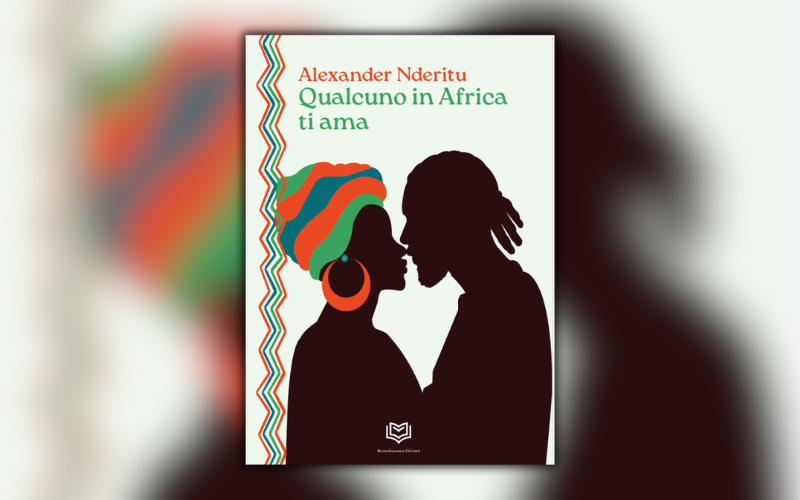
In a new bilingual poetry collection titled Someone in Africa Loves You, author and poet Alexander Nderitu does not rely on Italian translation to bridge Africa and other parts of the world. Instead, the experiences flow into each other and explore themes of love, mental health, and hardship.
For instance, the opening poem, Someone in Africa Loves You, tells the story of a cross-cultural romance between a British university student and a Kenyan beach boy, set along the Kenyan coast. The poem incorporates references to coastal heritage sites such as Fort Jesus and the Gedi Ruins while appealing to universal themes of connection and longing.
Another poem, Hanging Lives, is taken from the Italian practice of suspended coffee, where well-off customers pay in advance for those in need, a gesture of human kindness. The poem is also inspired by the real-life death of a young Nigerian poet by suicide, therefore weaving together themes of generosity, hardship and mental health.
“I wrote Hanging Lives, about a destitute former professor who survives via “hanging coffees”. In honour of the young poet, I set the poem near a university in Nigeria and addressed the theme of depression,” Nderitu says.
Nderitu has released this new bilingual poetry collection on April 2, 2026, titled Someone in Africa Loves You, also published in Italy as Qualcuno in Africa ti ama.
The book, translated into Italian by Valeria Paolini and published in Italy by Nonsolopoesie Edizioni, marks his first publication since 2023 and his first full-length book to debut in a foreign market ahead of his home audience. With this new release, Nderitu returns to poetry after a period focused on editing, literary programming and cultural initiatives.
Someone in Africa Loves You is a collection of 78 poems in English alongside their Italian translations that are positive and uplifting. The author, known for his measured pace in writing poetry, said the book emerged from years of accumulated work instead of a single burst of creativity.

“Despite being born on William Shakespeare’s birthday, 23rd of April, and enjoying poetry since childhood, I write poems very slowly. For me to compose a poem, I have to be inspired by something or someone,” he says.
Over the past two decades, Nderitu has compiled quite a large number of poems, and when he wants to publish a collection, he goes back to these old pages and looks for a theme.
“First, I selected the love-themed and motivational poems from my collection. Once I placed all the ones I was going to use in the manuscript, I once again moved them around like bricks so that there would be some kind of internal logic,” he recalls.
The poem first reached a global audience during the Commonwealth Games 2014 in Scotland, where it was selected to represent Kenya in the Commonwealth Poetry Postcards cultural programme. The initiative featured poems from participating countries, distributed as postcards and broadcast during the Games.
Nderitu recalled that a UK radio station discovered his work online and invited him to contribute. Of the two poems he submitted, Someone in Africa Loves You was chosen.
More than a decade later, the poem is unchanged in meaning for the author.
“It’s exactly what I wanted it to be, which is a heart-warming, cross-cultural love story told in verse. Revisiting it after so many years did make me appreciate it more,” he says.
The poem has since been translated into several languages, including Kiswahili, Arabic, Chinese, Gikuyu, and Dholuo. There are some lines that Nderitu is really proud of, such as “Her eyes were as blue as the cloud-starved African sky”, “A massive orange sun leapt over the horizon like a tiger”, and “palm fronds swaying in a wind-conducted symphony”.
An Italian writer, named Ada Rizzo, recently published a review of that particular poem. She described it as “a universal story, where the beauty of the landscape and the power of love become shared heritage”.

While romantic love is central to the collection, the book explores extensive interpretations of the theme, including love for country, nature, language, and literature. He intentionally leaves these meanings open-ended to allow readers to form their own interpretations.
The concept of belonging, hinted at in the book’s blurb, runs through the collection as poems travel between cities and savannahs, memory and desire, spirituality and everyday life, myth and pop culture, politics and tenderness, and humour and pain.
“These poems are born in Africa, but they do not remain confined here as they travel between these themes. Every book I write assumes that Africa is the centre of the world, so everything is viewed through a Pan-Africanist lens,” he says.
In this particular work, there are poems like Everybody Knows a Kamau, The Nile, and Daughters of Eve that glow with African pride and love for African cultures and natural heritage. Earlier collections such as King Bure is Dead! And where the Kremlin lives is also in the book.
The collection blends humour, irony, politics and pop culture with more introspective themes. Nderitu said this portrays the complexity of everyday life.
“Emotional and serious themes are counterpoints to each other. No story only has good or bad stuff going on. You’ve got to have the good and the bad, the highs and the lows; like a roller-coaster ride,” he explains.
This approach is also evident in the book’s unconventional titles, including The Quantum Mechanics of Love and The Pope is Getting Married, which are designed to intrigue readers while aligning with the poems’ underlying ideas.
The bilingual format represents a significant step in the author’s career. Although his work has previously appeared internationally, this is the first time an entire collection has been launched abroad before reaching readers here.
Like Ngũgĩ wa Thiong’o, Nderitu views translation as a bridge between cultures that enables literature to cross linguistic and geographic boundaries without losing its identity. He noted that translation has already opened new audiences for his work in regions where English is not widely spoken.
“Even within Africa, there are huge populations that speak languages such as Arabic, French, Zulu, Shona, Hausa, Igbo, and Afrikaans. I hope that one day my works will be translated into all major languages, preferably by human translators,” he says.
Translator Valeria Paolini approached the project with a focus on preserving meaning and tone instead of literal phrasing. In the book’s foreword, she explains that the translation prioritises fluidity, musicality and emotional resonance, adapting the Italian language where necessary to maintain the poems’ impact.
Cultural references and wordplay were interpreted through equivalent expressions, while Kiswahili words were retained and explained through footnotes to preserve their original context.