

Audio By Vocalize
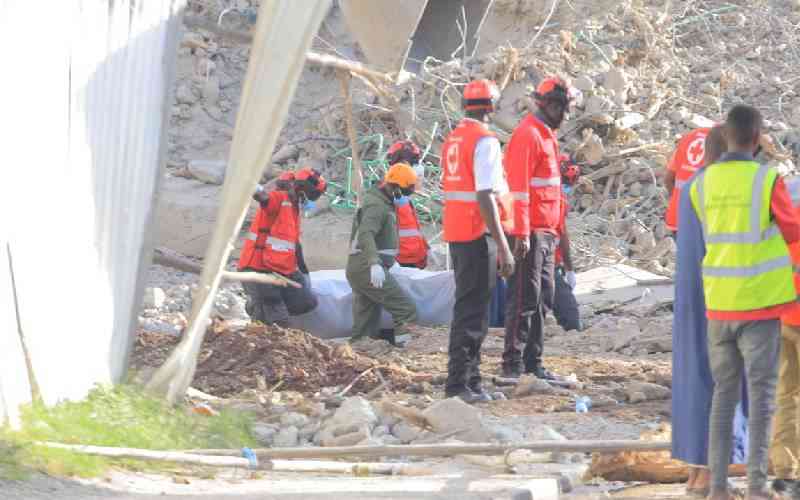
Rescue workers after covering a body from the rubble of the collapsed building in South C, Nairobi, on January 4, 2026. [File, Standard]
When a crisis hits in this country; be it floods, road accidents, epidemics and displacement, there is always someone who shows up first on the scene. A responder. A volunteer. A humanitarian worker. Not because it’s easy but because it’s needed.
But often we forget that humanitarian work is dependent on the safety of humanitarian service providers. It’s become evident from recent events that humanitarian action is not only about saving lives but also about the risks humanitarian workers take on. Organisational and community safety go hand in hand. In Kenya, humanitarian responders are not outsiders to a community, they are part of it. When responders aren’t safe, communities aren’t safe either. So, for humanitarian responses to be safe, safety needs to be moved from an internal and technical issue to a national concern.
Humanitarian responses are based on the principle of humanity to save lives and dignity. But this is best achieved at community levels, where people live their experiences of crisis and response.
Across Kenya, communities consistently remember when responders came to support them during floods, fires and other disasters. These lived experiences shape trust. They shape whether people seek help. They impact the effectiveness of humanitarian aid.
But what happens when the very people communities rely on are exposed to harm? Responders are not the only ones affected by risks, whether physical, climatic or systemic. They affect service delivery, response time and most importantly the relationship between communities and humanitarian systems. So, the safety of responders is not “in addition to” serving communities. It is central to it.
Traditionally, operational safety has been seen as the responsibility of humanitarian organisations. That framing and thinking is no longer sufficient. The humanitarian system today is dynamic. It is linked with infrastructure, transport, occupational health and safety, technology and policy. This means there is a whole-of-society responsibility to ensure responders’ safety.
Public authorities need to develop and improve regulatory frameworks and enforcement. Businesses must provide innovation, technology and infrastructure solutions.
Humanitarian agencies need to continue to strengthen their systems, training and duty of care.
And communities must be involved in developing solutions to their problems. It’s a change of mindset we need, from individual to collective accountability.
As we celebrate World Red Cross Day 2026 with the theme “Keeping Humanity Alive” action is not only required, it is called for. It is a moment to shift the perspective on humanitarian work, not just as service provision but as a system that must equally protect those who receive assistance and those who provide it. The International Center for Humanitarian Affairs (ICHA), of the Kenya Red Cross Society, is working to promote this agenda through its policy and advocacy work. This means bringing to the fore the realities of responders and communities, creating evidence to guide policy and practice, bringing different stakeholders, government, private sector and humanitarian, to the table, and translating evidence-based recommendations into various policy products; access ICHA publications via https://icha.net/publications/ ). This is not about awareness, but solutions and change.
To keep humanity alive we need more than goodwill. It requires systems that work. It requires partnerships that deliver. It requires keeping those who enable humanitarian action safe. Responder safety is not an isolated issue, it underpins humanitarian action.
If we are not able to protect those who are serving, we run the risk of compromising the very systems that communities rely on in times of vulnerability. But if we do something, as a collective, and in a focused, strategic way, we can create a humanitarian system that is effective, safe, trusted and sustainable. Because ultimately, in order to keep humanity alive, we must protect, support reward those who bear it.
—The writer is the Policy and Advocacy Expert at ICHA, Kenya Red Cross Society
Support Independent Journalism
Stand With Bold Journalism.
Stand With The Standard.
Continue
→
Pay via
Secure Payment
Kenya’s most trusted newsroom since 1902
Follow The Standard on
Rescue workers after covering a body from the rubble of the collapsed building in South C, Nairobi, on January 4, 2026.
[File, Standard]
When a crisis hits in this country; be it floods, road accidents, epidemics and displacement, there is always someone who shows up first on the scene. A responder. A volunteer. A humanitarian worker. Not because it’s easy but because it’s needed.
But often we forget that humanitarian work is dependent on the safety of humanitarian service providers. It’s become evident from recent events that humanitarian action is not only about saving lives but also about the risks humanitarian workers take on. Organisational and community safety go hand in hand. In Kenya, humanitarian responders are not outsiders to a community, they are part of it. When responders aren’t safe, communities aren’t safe either. So, for humanitarian responses to be safe, safety needs to be moved from an internal and technical issue to a national concern.
Humanitarian responses are based on the principle of humanity to save lives and dignity. But this is best achieved at community levels, where people live their experiences of crisis and response.
Across Kenya, communities consistently remember when responders came to support them during floods, fires and other disasters. These lived experiences shape trust. They shape whether people seek help. They impact the effectiveness of humanitarian aid.
But what happens when the very people communities rely on are exposed to harm? Responders are not the only ones affected by risks, whether physical, climatic or systemic. They affect service delivery, response time and most importantly the relationship between communities and humanitarian systems. So, the safety of responders is not “in addition to” serving communities. It is central to it.
Traditionally, operational safety has been seen as the responsibility of humanitarian organisations. That framing and thinking is no longer sufficient. The humanitarian system today is dynamic. It is linked with infrastructure, transport, occupational health and safety, technology and policy. This means there is a whole-of-society responsibility to ensure responders’ safety.
Public authorities need to develop and improve regulatory frameworks and enforcement. Businesses must provide innovation, technology and infrastructure solutions.
Humanitarian agencies need to continue to strengthen their systems, training and duty of care.
And communities must be involved in developing solutions to their problems. It’s a change of mindset we need, from individual to collective accountability.
As we celebrate World Red Cross Day 2026 with the theme “Keeping Humanity Alive” action is not only required, it is called for. It is a moment to shift the perspective on humanitarian work, not just as service provision but as a system that must equally protect those who receive assistance and those who provide it. The International Center for Humanitarian Affairs (ICHA), of the Kenya Red Cross Society, is working to promote this agenda through its policy and advocacy work. This means bringing to the fore the realities of responders and communities, creating evidence to guide policy and practice, bringing different stakeholders, government, private sector and humanitarian, to the table, and translating evidence-based recommendations into various policy products; access ICHA publications via https://icha.net/publications/ ). This is not about awareness, but solutions and change.
To keep humanity alive we need more than goodwill. It requires systems that work. It requires partnerships that deliver. It requires keeping those who enable humanitarian action safe. Responder safety is not an isolated issue, it underpins humanitarian action.
If we are not able to protect those who are serving, we run the risk of compromising the very systems that communities rely on in times of vulnerability. But if we do something, as a collective, and in a focused, strategic way, we can create a humanitarian system that is effective, safe, trusted and sustainable. Because ultimately, in order to keep humanity alive, we must protect, support reward those who bear it.
—The writer is the Policy and Advocacy Expert at ICHA, Kenya Red Cross Society
Stay informed. Subscribe to our newsletter
By Jilly Kaunda