

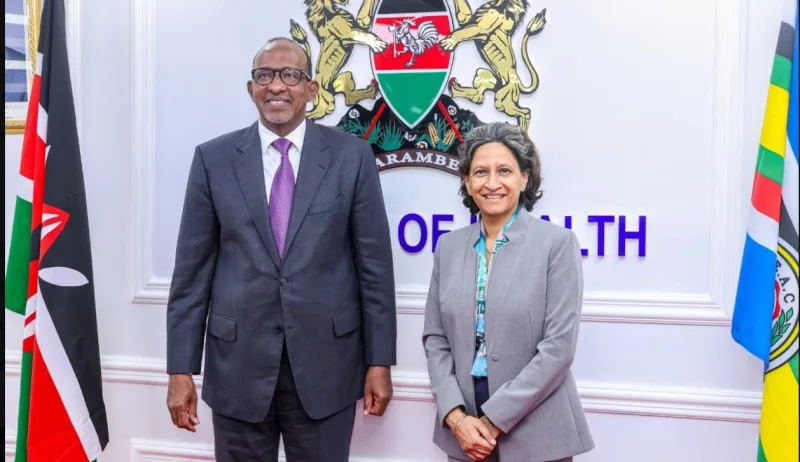
Health Cabinet Secretary Aden Duale has sought the World Bank’s support in expanding digital health services and strengthening Kenya’s health emergency preparedness as the country advances Universal Health Coverage (UHC).
Duale hosted a World Bank delegation led by Vice President for Human Development Mamta Murthi for a bilateral consultative meeting on the Building Resilient and Responsive Health Systems (BREHS) and Kenya Health Emergency Preparedness, Response and Resilience (KHEPRR) projects.
The two projects are being implemented across all 47 counties, with a focus on refugee-hosting and underserved areas. They support primary healthcare, emergency preparedness and response, quality of care and patient safety.
Duale said all Implementation Partner Agreements for the projects had been signed, paving the way for accelerated implementation.
He also briefed the delegation on the government’s ongoing health sector transformation under the Taifa Care Model, including the expansion of the Social Health Authority (SHA).
“So far, 32.6 million Kenyans, or 68% of the population, have been onboarded, with 11,197 healthcare providers contracted and KSh178 billion paid for services rendered,” Duale said.
The meeting also focused on the transformation of the Pharmacy and Poisons Board as Kenya works towards achieving World Health Organisation Maturity Level 3.
Duale said strengthening local manufacturing of health products and technologies remained critical, noting that about 70% of the products are still imported.
“Building domestic production capacity remains central to our pursuit of UHC and health sovereignty,” he said.
He said the agenda was being supported by Kenya’s ratification of the African Medicines Agency Treaty, the launch of the Health Products and Technologies Local Manufacturing Strategic Plan and the upcoming Africa Health Products Manufacturing Summit scheduled for December 3–5.
Duale also sought World Bank support to extend connectivity to 2,500 health facilities in remote and underserved areas to strengthen digital health services and enable their participation in Kenya’s emerging digital health ecosystem.
He further sought support for the Every Woman Every Newborn Everywhere (EWeNE) initiative, which uses real-time data to target interventions aimed at reducing preventable maternal and newborn deaths.
According to Duale, three of the 20 counties identified as having a high burden of maternal and newborn deaths have exited the list six months after the initiative was launched.
Duale commended the World Bank for its longstanding partnership with Kenya and called for closer coordination of development partner support around national priorities.
He advocated for “One Plan, One Budget and One Evaluation” to improve coordination, transparency, accountability and measurable results in the health sector.
Principal Secretary for Medical Services Dr Ouma Oluga, SHA CEO Dr Mercy Mwangangi, Digital Health Agency CEO Eng Anthony Lenayara and World Bank Practice Manager Ronald Mutasa were among those who attended the meeting.