

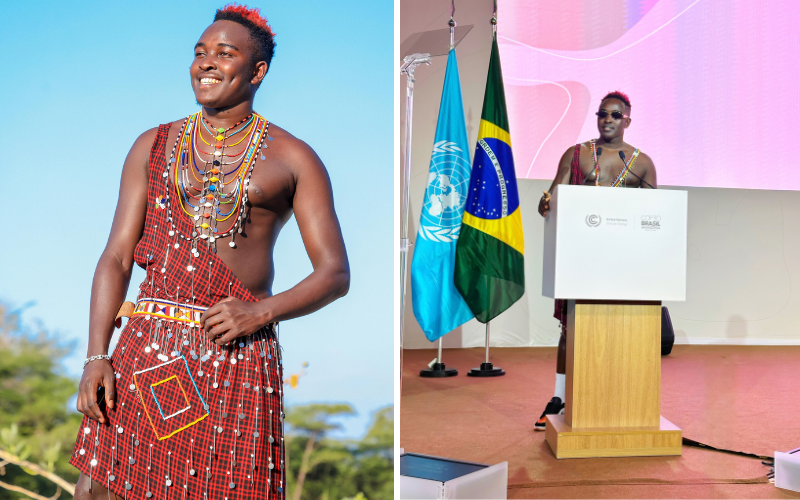
For Leshao Sopia Leshao, climate change is not simply a subject discussed at international conferences. It is an issue he has watched affect pastoralist communities whose livelihoods depend on livestock, water and pasture.
The Maasai musician, civil engineer and climate justice advocate has turned to music as a way of connecting those experiences with audiences beyond the communities where they occur.
Leshao, who grew up around the Maasai Mara, began his musical journey in 2019 while still in high school. He became more serious about music in 2022 while at university, developing a sound that combines contemporary music with traditional Maasai rhythms.
“I chose to sing in Maa because I believe our language and culture deserve to be heard, celebrated and preserved,” he says.
His work comes against a backdrop of increasingly unpredictable weather in Kenya.
The Kenya Meteorological Department says the country’s average temperature has risen by about 0.88 degrees Celsius since 1960, while rainfall patterns have become more unpredictable. The department also reported that 2024 was Kenya’s hottest year on record. (KMD)
For pastoralist communities, such changes can have direct consequences. Leshao says prolonged droughts, floods and changing weather patterns affect livestock survival, access to water and pasture, household incomes and food security.
“I am not a climate scientist, but I am an artist with a voice and a platform,” he says. “I realised that music could help communicate the human experiences behind climate statistics and policy discussions.”
His climate advocacy developed further through work with Spring of the Arid and Semi-Arid Lands (SASAL), a youth- and women-led organisation working with pastoralist communities.
The collaboration resulted in two climate-focused songs, Esipata Oloing’ange and ESIANA. Leshao says the music is intended to bring climate conversations closer to communities through familiar cultural forms.
That approach has taken him beyond the music stage.
He has participated in international climate spaces including COP29, SB62, COP30 and SB64, where he sought to bring Indigenous and pastoralist perspectives into discussions often dominated by technical and policy language.
Kenya’s recent climate experience has underlined the stakes. The Kenya Meteorological Department reported that food insecurity rose from about one million people in July 2024 to 2.15 million by February 2025 following poor short rains. (KMD)
Alongside music and advocacy, Leshao completed a degree in civil engineering at Meru University of Science and Technology in October 2024.
He sees the two disciplines as complementary, describing engineering as a source of discipline and problem-solving skills, while music gives him another way to communicate.
“Climate justice requires policy action, resources, community participation and the recognition of Indigenous knowledge,” he says. “However, I believe artists can contribute by making these issues visible, communicating lived experiences and encouraging people to engage with them.”