

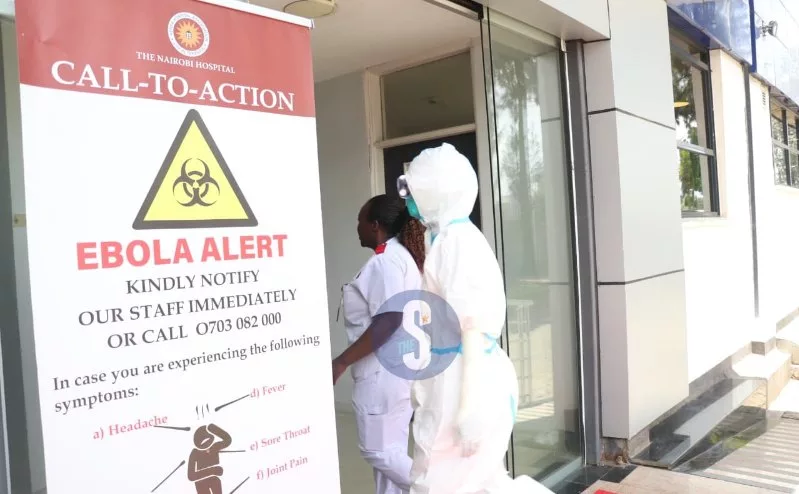
KNH when it conducted Ebola simulation.
Kenya has placed travellers from 10 countries under
enhanced surveillance following the country’s first confirmed imported Ebola
case and death.
Health Cabinet Secretary Aden Duale said Wednesday that
passengers arriving from the Democratic Republic of Congo (DRC), Uganda,
Tanzania, Rwanda, Burundi, Angola, Zambia, Ethiopia, South Sudan and the
Central African Republic will face additional screening at the Jomo Kenyatta
International Airport (JKIA).
Speaking at Nairobi Hospital, where the first Ebola patient
was treated before dying on Tuesday, Duale said aircraft arriving from the 10
countries will be directed to Gate 16 at JKIA, where passengers will undergo
enhanced health screening.
“The Ministry of
Health is committed to protecting the public against public health threats and
will continue to update the public on measures that the government is putting
in place to mitigate the spread of the disease,” he said.
Passengers arriving from the affected countries will be
screened for possible signs of illness and required to provide information
through health declaration forms before proceeding into the country.
The measures come a day after Kenya confirmed its first
Ebola case in a traveller who had entered the country from the DRC on October
3.
The patient was admitted to Nairobi Hospital on Saturday but
died on Monday night. The Ministry of Health, working with the Kenya Red Cross
Society, subsequently conducted what they called “a safe and dignified burial
in line with public health measures” on Tuesday.
The government has identified five hospitals to
treat confirmed Ebola patients as it prepares for the possibility of more
cases.
They are Kenyatta National Hospital, which has eight beds,
Moi Teaching and Referral Hospital with 50 beds, National Police Hospital with
49 beds, Portreitz Hospital with four beds and Nairobi Hospital with 130 beds.
Duale said the capacity could be expanded depending on how
the situation develops.
“This capacity will increase with the establishment of more
facilities as the situation evolves. In addition, five facilities, namely
Malaba Health Centre, Busia Border and Kocholia, have been designated as
temporary isolation centres for suspected cases,” he said.
“Alupe Sub District Hospital in Busia County is undergoing
renovations to manage Ebola Virus disease,” he said.
The government has also intensified preparedness at the
country’s borders, particularly at points through which travellers from
neighbouring countries enter Kenya.
Health officials are asking the public to remain alert but
calm as the government continues contact tracing and surveillance.
Duale urged Kenyans to maintain good hand hygiene, avoid
contact with people showing symptoms of illness and report suspected cases to
health authorities.
“Kenyans are urged to remain calm and vigilant, practise
strict hand hygiene, avoid contact with sick people showing symptoms, and
immediately report any suspected symptoms or possible exposure to health
authorities at a recognised health facility,” he said.
“The public is reminded to seek care at a recognised health
facility if unwell. The public is also encouraged to report any known unwell
individuals to the nearest facility,” Duale said.
He also warned the public against relying on unverified
information about the disease, urging Kenyans to use official Ministry of
Health communication channels.
“The public is further urged to obtain information from the
official Ministry of Health platforms and the toll-free line 719,” he said.
The ministry is working with county governments and other
health facilities to strengthen surveillance and prepare for a possible
increase in suspected cases.
The government has also begun mobilising additional
resources for the response, with the National Treasury setting aside an initial
Sh2.6 billion for Ebola preparedness and containment.
The ministry says the current case is an imported infection
and is being managed through contact tracing, quarantine, enhanced surveillance
and treatment preparedness.
Health officials are continuing efforts to locate and place
the remaining identified contacts under appropriate monitoring while those
already quarantined are being observed for symptoms.